
Over 80 percent of american businesses now rely on Customer Relationship Management systems to keep pace with growing professional networks. The shift to integrating LinkedIn makes a big difference, giving teams instant access to fresh lead data and real-time insights. As buyers and business partners expect faster, more personalized outreach, understanding how to connect LinkedIn to CRM tools sets the stage for better results and smarter strategies.
Key Takeaways
| Point | Details |
|---|---|
| Integration Enhances Efficiency | Connecting LinkedIn to CRM automates data synchronization and reduces manual entry, streamlining workflows for sales and marketing teams. |
| Sales Intelligence Improvement | Real-time access to LinkedIn insights allows teams to develop comprehensive prospect profiles and enhance lead qualification processes. |
| Collaboration and Data Accuracy | A unified platform improves team collaboration and ensures centralized, accurate customer information, breaking down silos across departments. |
| Compliance and Risk Management | Organizations must prioritize data privacy protocols and compliance measures to mitigate risks associated with data integration. |
Connecting LinkedIn to CRM: Core Concepts
Connecting LinkedIn to your Customer Relationship Management (CRM) system transforms how sales and marketing professionals capture, track, and leverage professional network data. According to Martech, this integration allows sales teams to access critical LinkedIn insights directly within their CRM, enabling real-time data synchronization and dramatically streamlined data entry processes.
The core concept behind LinkedIn CRM integration revolves around creating comprehensive professional profiles. By merging social media interaction data with existing customer information, businesses can develop a more nuanced understanding of their contacts. Microstartups highlights that this approach allows organizations to collect social media behaviors and interactions, ultimately building more robust customer profiles.
Key benefits of connecting LinkedIn to CRM include:
- Automatic contact information updates
- Enhanced lead qualification processes
- Real-time professional network insights
- Reduced manual data entry
- Improved sales intelligence
Successful integration means transforming disconnected data points into a unified view of your professional relationships. Sales professionals gain unprecedented visibility into potential leads, their career trajectories, and mutual connections. This strategic approach turns your CRM from a simple contact database into a dynamic intelligence platform that adapts and grows with your professional network.

Main Benefits for Sales and Marketing Teams
Connecting LinkedIn to CRM delivers transformative advantages for sales and marketing professionals, fundamentally reshaping how teams approach customer relationship management. Blogs.uoc.edu reveals that CRM systems significantly enhance sales efficiency by providing a comprehensive view of the customer lifecycle, enabling more strategic management of sales opportunities and dramatically improving conversion rates.
Sales Intelligence Enhancement becomes a critical benefit of this integration. By bridging data from LinkedIn and CRM platforms, teams gain unprecedented insights into prospect backgrounds, professional networks, and potential engagement pathways. Rethinkscience highlights how CRM services create a collaborative environment, allowing sales and marketing teams to access comprehensive customer interaction histories and develop more targeted campaigns.
Key advantages of LinkedIn CRM integration include:
- Real-time professional network tracking
- Automated contact information updates
- Comprehensive prospect profile development
- Enhanced lead qualification processes
- Seamless cross-team collaboration
Understanding these benefits means recognizing that modern sales strategies demand dynamic, interconnected intelligence platforms. By integrating LinkedIn data directly into CRM systems, organizations transform disconnected information into actionable insights.
Sales and marketing teams can now move beyond traditional contact management, creating more personalized, data-driven engagement strategies that adapt to the complex professional landscapes of today’s business environment.
Workflow Integration and Automation Features
Workflow integration between LinkedIn and CRM systems represents a breakthrough in professional productivity and data management. UMA Technology highlights that CRM-integrated tools dramatically transform operational efficiency by automating repetitive tasks such as email follow-ups and report generation, allowing teams to redirect their focus toward strategic business activities.
Automated Data Synchronization emerges as a cornerstone of this integration, enabling seamless information transfer between professional networking platforms and customer relationship management systems. This automated approach eliminates manual data entry, reduces human error, and ensures that contact information remains consistently updated across multiple platforms. Sales professionals can now capture LinkedIn profile details, connection insights, and professional interactions with a single click, streamlining their lead management processes.
Key workflow automation features include:
- One-click contact profile importing
- Automatic LinkedIn connection tracking
- Real-time professional data updates
- Intelligent lead scoring mechanisms
- Integrated communication history logs
The true power of workflow integration lies in its ability to create a unified, intelligent ecosystem where data flows naturally between platforms. By removing friction from information collection and management, sales and marketing teams can focus on building relationships, developing strategies, and driving meaningful business growth. These automated workflows transform complex, time-consuming processes into smooth, efficient interactions that adapt to the dynamic nature of professional networking and customer relationship management.
Improving Data Accuracy and Team Collaboration
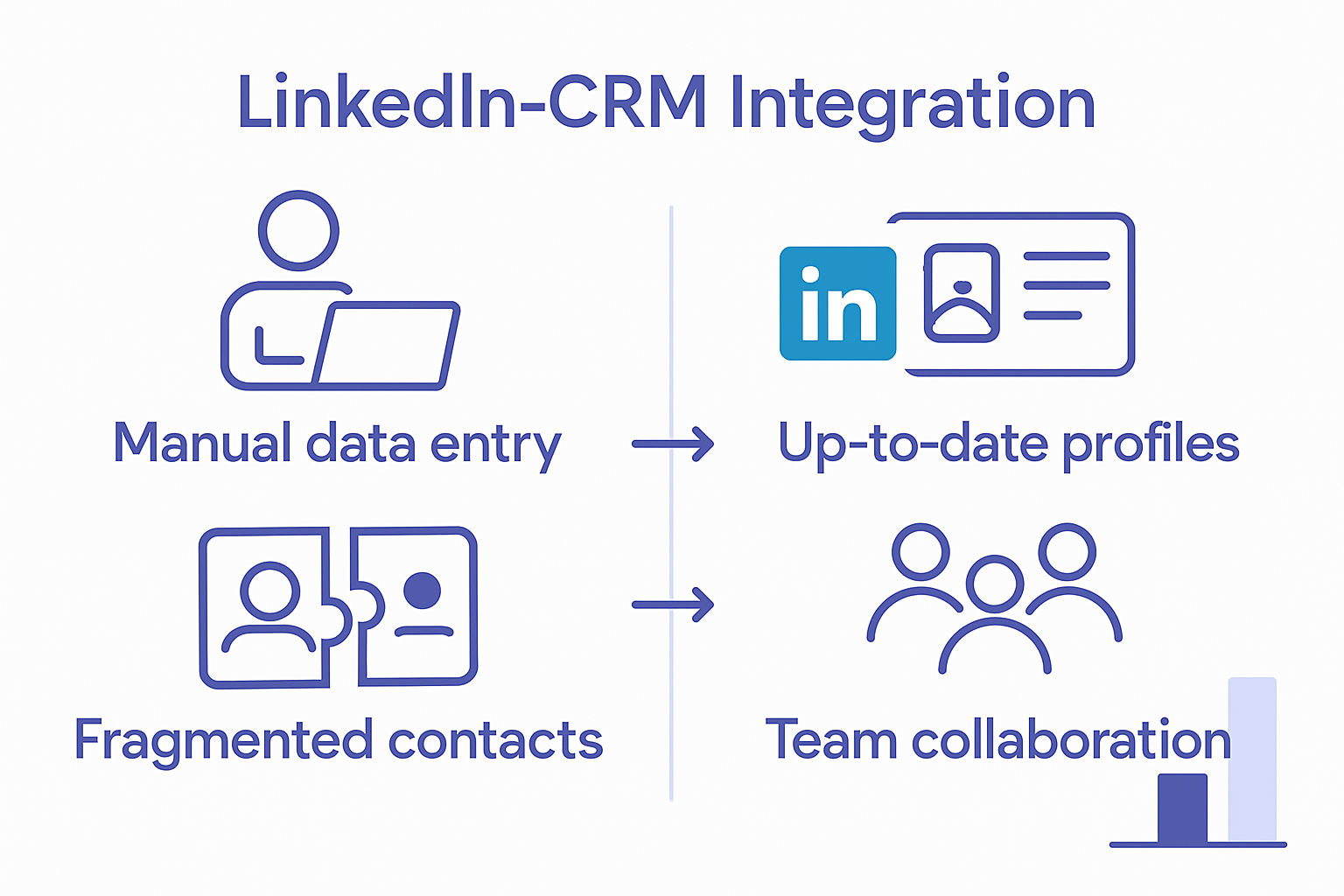
CRM.org underscores a critical advantage of integrating LinkedIn with CRM systems: dramatically improved data accuracy through a centralized platform for customer information. By eliminating fragmented data sources, organizations can reduce manual errors and create a single, reliable source of truth for customer interactions and professional network details.
Collaborative Intelligence represents the next frontier of team productivity. Baby Boomer highlights how CRM systems enhance cross-functional communication by providing a shared platform for customer information and interactions. This approach breaks down traditional departmental silos, enabling sales, marketing, and customer service teams to access comprehensive, real-time insights about potential and existing clients.
Key strategies for improving data accuracy and collaboration include:
- Centralized contact information management
- Automatic profile synchronization
- Transparent interaction tracking
- Shared visibility across team departments
- Real-time data validation mechanisms
The ultimate goal of LinkedIn CRM integration goes beyond mere data collection. It creates an ecosystem where information becomes a dynamic, collaborative asset. Teams can now work with unprecedented transparency, leveraging shared insights to develop more targeted strategies, reduce redundant efforts, and create a more cohesive approach to customer relationship management. By transforming data from a static resource into a living, evolving intelligence platform, organizations can unlock more strategic and meaningful professional interactions.
Compliance, Risks, and What to Avoid
Navigating the complex landscape of data integration requires a strategic approach to compliance and risk management. CRM.org emphasizes that modern CRM systems come equipped with built-in security features designed to meet rigorous regulatory standards, including automatic logging and comprehensive interaction archiving. These mechanisms are crucial for protecting sensitive professional network data and maintaining organizational integrity.
Data Privacy Protocols represent a critical consideration in LinkedIn CRM integration. UMA Technology warns that while integrated tools can significantly improve operational efficiency, organizations must proactively ensure data privacy and compliance to mitigate potential risks. This means implementing robust consent mechanisms, understanding platform-specific data usage policies, and maintaining transparent data handling practices.
Key compliance and risk mitigation strategies include:
- Obtaining explicit user consent for data collection
- Implementing role-based access controls
- Regularly auditing data integration processes
- Maintaining comprehensive data usage documentation
- Establishing clear opt-out mechanisms
Successful LinkedIn CRM integration demands a holistic approach that balances technological innovation with stringent ethical standards. Organizations must view data protection not as a constraint, but as an opportunity to build trust, demonstrate professionalism, and create more meaningful, consent-driven professional relationships. By prioritizing transparency, security, and individual privacy, teams can leverage powerful integration tools while maintaining the highest standards of data governance and professional respect.
Unlock Seamless LinkedIn to CRM Integration for Smarter Prospecting
The article highlights the challenges sales and marketing teams face with cumbersome manual data entry, inconsistent contact information, and fragmented workflows when trying to connect LinkedIn with CRM systems. With key concepts like real-time professional network tracking, automated data synchronization, and improved team collaboration, the goal is clear: transform your CRM into a dynamic, intelligent platform that keeps pace with your ever-growing network.
If you are looking to eliminate repetitive tasks and gain instant access to rich LinkedIn insights directly in your CRM, LeadLx offers the perfect solution. Our SaaS platform specifically integrates LinkedIn with CRM tools such as HubSpot and Salesforce, enabling one-click contact imports, bulk data extraction from LinkedIn search results, and automatic updates to your CRM data. Say goodbye to switching between tabs and wasting hours on manual updates — with LeadLx, your prospecting becomes effortless, accurate, and collaborative.
Experience how our powerful browser extension overlays HubSpot data onto LinkedIn profiles and streamlines your lead management workflow today. Discover the difference LeadLx can make and take control of your sales intelligence and data accuracy now.
Ready to revolutionize your LinkedIn to CRM process and save valuable time every week?
Don’t wait to boost productivity and close more deals. Visit LeadLx to start your free trial and transform your prospecting strategy today.
Frequently Asked Questions
What are the main benefits of connecting LinkedIn to CRM?
Connecting LinkedIn to your CRM provides several key benefits, including automatic contact information updates, enhanced lead qualification processes, real-time professional network insights, reduced manual data entry, and improved sales intelligence.
How does LinkedIn CRM integration improve data accuracy?
LinkedIn CRM integration enhances data accuracy by eliminating fragmented data sources and creating a centralized platform for customer information. This reduces manual errors and ensures a single, reliable source of truth for customer interactions.
What workflow automation features are available with LinkedIn CRM integration?
Key workflow automation features include one-click contact profile importing, automatic LinkedIn connection tracking, real-time professional data updates, intelligent lead scoring mechanisms, and integrated communication history logs.
How can I ensure compliance and data privacy in LinkedIn CRM integration?
To ensure compliance and data privacy, organizations should obtain explicit user consent for data collection, implement role-based access controls, regularly audit data integration processes, maintain comprehensive data usage documentation, and establish clear opt-out mechanisms.