
Over eighty percent of American businesses now rely on digital platforms to reach new clients, yet finding accurate contact details can be a major challenge. Whether you are in sales, marketing, or lead generation, the quality of your contact data shapes every outreach effort. Understanding the exact process behind contact data extraction could be the key to building stronger connections and giving your team a measurable edge.
Key Takeaways
| Point | Details |
|---|---|
| Contact Data Extraction | A strategic method for collecting contact information from digital sources to enhance sales and marketing efficiency. |
| Automation Benefits | Automating data extraction saves time, increases accuracy, and improves customer relationship management effectiveness. |
| Extraction Methods | Techniques like web scraping and API integration allow for diverse data collection from structured and unstructured formats. |
| Legal Compliance | It’s vital for organizations to ensure compliance with privacy laws and obtain user consent when extracting data. |
What Is Contact Data Extraction? Core Definition and Key Concepts
Contact data extraction is a strategic process of retrieving and collecting contact information from various digital sources to streamline sales and marketing workflows. At its core, this technique involves systematically pulling contact details from unstructured or semi-structured digital environments like websites, social media platforms, professional networking sites, and email archives.
The fundamental goal of contact data extraction goes beyond simple information gathering. Sales professionals use this method to build comprehensive databases of potential leads, clients, and business contacts. By automating the process of collecting names, email addresses, phone numbers, job titles, and company information, teams can dramatically reduce manual data entry time and improve the accuracy of their customer relationship management (CRM) systems.
Technically, contact data extraction operates through multiple mechanisms. Some approaches utilize web scraping technologies that can navigate digital platforms and extract publicly available contact information. Other methods involve accessing specific data repositories to retrieve contact details with appropriate permissions. Advanced extraction tools now incorporate machine learning algorithms that can recognize and categorize contact information across complex digital landscapes, ensuring higher precision and relevance in data collection.
Key benefits of robust contact data extraction include:
- Significant time savings in lead generation
- Improved data accuracy and completeness
- Enhanced targeting capabilities for marketing campaigns
- Reduced manual data entry errors
- Faster sales cycle progression
As digital communication channels continue to expand, contact data extraction represents a critical technology for modern sales and marketing teams seeking to optimize their prospecting and relationship management strategies.
Types of Contact Data and Extraction Methods
Contact data comes in diverse formats, each requiring specialized extraction techniques. Organizations can categorize contact information across structured, semi-structured, and unstructured data types, which fundamentally determines the approach for successful data retrieval and management.
Structured contact data represents the most straightforward category, typically found in organized databases, spreadsheets, and standardized CRM systems. These data sources contain neatly arranged contact details like names, email addresses, phone numbers, and job titles, allowing for direct and predictable extraction methods. Sales teams can easily import or synchronize these datasets using standard integration protocols and API connections.
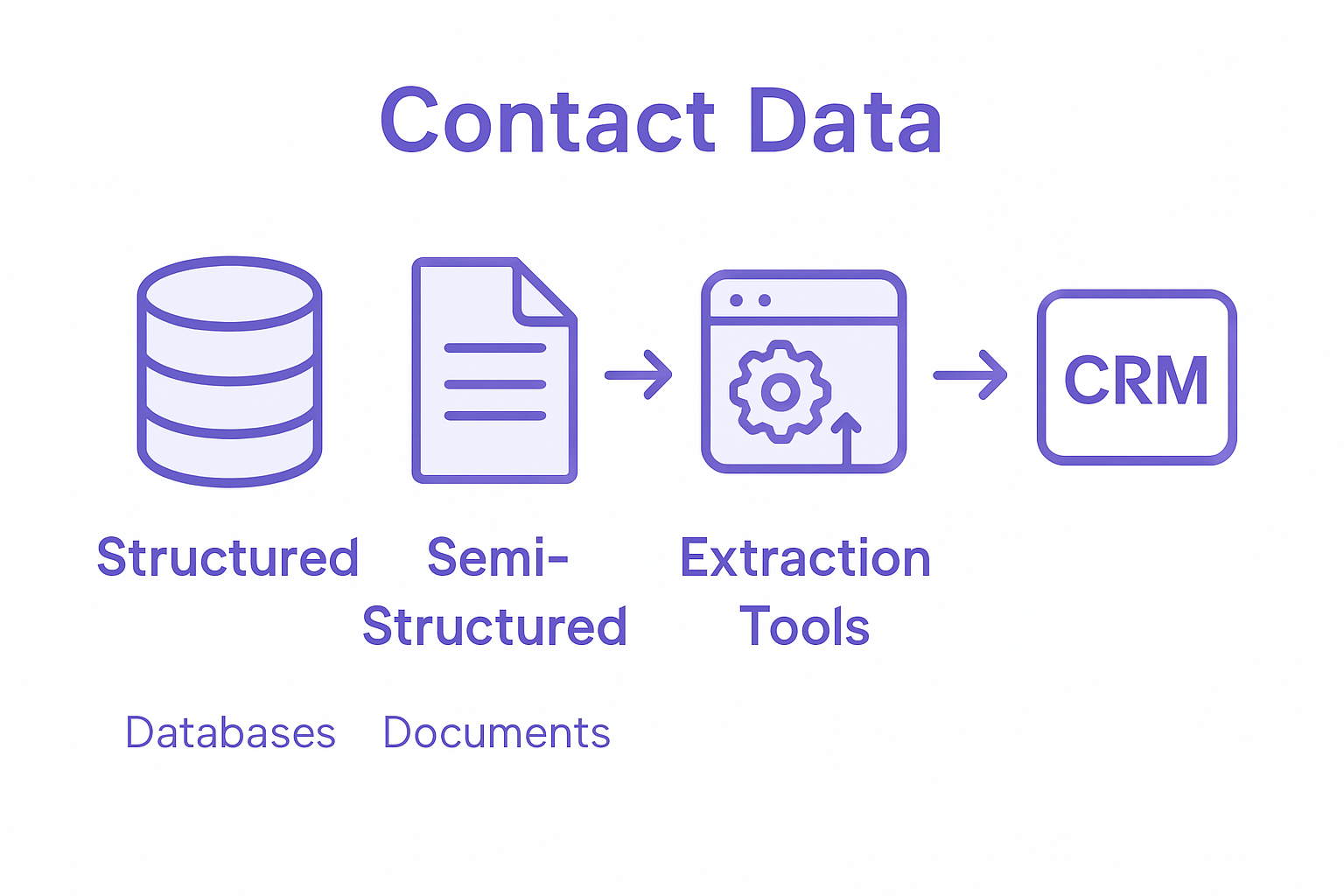
Unstructured and semi-structured data present more complex extraction challenges. These formats include emails, social media profiles, business cards, and web pages where contact information is embedded within narrative or variable layouts. Advanced extraction technologies now employ machine learning algorithms and natural language processing to identify, parse, and validate contact details from these intricate sources, transforming raw digital content into actionable business intelligence.
Key extraction methods for different contact data types include:
- Manual Entry: Direct input of contact details
- Web Scraping: Automated retrieval from online sources
- API Integration: Direct data pull from connected platforms
- Batch Processing: Bulk extraction of contact information
- Real-Time Extraction: Immediate data capture during interactions
As digital communication continues evolving, contact data extraction methods must become increasingly sophisticated, balancing technological capabilities with ethical data collection practices and compliance requirements.
How Automated Extraction Tools Work With LinkedIn and CRMs
Automated extraction tools leverage sophisticated technologies to bridge the gap between professional networking platforms and customer relationship management systems. Named-entity recognition techniques enable precise identification and classification of contact information across complex digital landscapes, transforming raw online data into structured, actionable business intelligence.

The core mechanism of these tools involves advanced web scraping technologies that systematically parse LinkedIn profiles and other professional networking sites. Data scraping processes convert unstructured web page content into clean, organized contact datasets that can be seamlessly integrated into CRM platforms. These automated systems use machine learning algorithms to extract critical details like names, job titles, email addresses, phone numbers, and company information with remarkable accuracy and speed.
Modern extraction tools typically operate through browser extensions or standalone applications that interact directly with LinkedIn’s interface. They employ intelligent parsing algorithms that can navigate complex profile structures, bypass potential blocking mechanisms, and capture contact details while maintaining compliance with platform terms of service. By using API connections and sophisticated data matching techniques, these tools ensure that extracted information is validated, deduplicated, and ready for immediate use in sales and marketing workflows.
Key technical capabilities of automated extraction tools include:
- Real-time data capture from LinkedIn profiles
- Automatic parsing of complex professional information
- Intelligent data validation and cleaning
- Seamless CRM integration
- Compliance with data privacy regulations
The evolution of these tools represents a significant leap in sales productivity, transforming time-consuming manual research into a streamlined, automated process that empowers sales professionals to focus on building relationships rather than data entry.
Applications for Sales, Marketing, and Lead Generation Teams
Contact scraping technologies provide powerful tools for sales and marketing professionals seeking to optimize their lead generation and customer relationship management strategies. By systematically gathering contact information from diverse digital sources, teams can transform their prospecting workflows, dramatically reducing the time and effort required to build comprehensive lead databases.
Lead Generation Teams leverage contact data extraction to identify and qualify potential customers with unprecedented precision. The ability to automatically compile detailed contact profiles enables these teams to create highly targeted outreach campaigns, segmenting prospects based on specific professional attributes, industry verticals, and organizational roles. Advanced data extraction methods support the development of personalized marketing strategies by providing rich, contextual information about potential leads.
Marketing departments benefit from contact data extraction by developing more sophisticated audience targeting approaches. These tools allow marketers to build nuanced customer personas, track professional transitions, and create dynamic segmentation models that adapt to real-time changes in professional networks. The granular insights generated through automated extraction enable more intelligent communication strategies, reducing waste and improving overall campaign effectiveness.
Key applications across different team functions include:
- Prospecting: Rapid identification of potential customers
- Lead Scoring: Automatic qualification and prioritization
- Account-Based Marketing: Precise targeting of key decision makers
- Sales Intelligence: Real-time professional background research
- Competitive Analysis: Tracking industry talent movements
By transforming manual research into automated, intelligent processes, contact data extraction empowers sales and marketing teams to focus on building relationships and driving revenue, rather than getting bogged down in time-consuming data collection tasks.
Legal Considerations and Data Privacy Compliance
Data scraping practices occupy a complex legal landscape with significant potential risks, requiring sales and marketing professionals to navigate carefully between technological capabilities and legal boundaries. While extracting publicly available information might seem straightforward, organizations must develop robust compliance strategies to protect themselves from potential legal challenges.
The primary legal considerations center around user consent, data privacy regulations, and platform-specific terms of service. Contact scraping activities can potentially violate privacy laws if conducted without appropriate permissions, making it critical for organizations to implement stringent verification processes. Different jurisdictions have varying requirements, with regulations like the General Data Protection Regulation (GDPR) in Europe and the California Consumer Privacy Act (CCPA) establishing strict guidelines about data collection, storage, and usage.
Companies engaged in contact data extraction must develop comprehensive compliance frameworks that address several key dimensions. This includes obtaining explicit consent from data subjects, maintaining transparent data collection practices, providing clear opt-out mechanisms, and implementing secure data storage and management protocols. Automated extraction tools should be configured to respect platform-specific restrictions, such as website robots.txt files and terms of service agreements that might prohibit automated data collection.
Key compliance considerations include:
- User Consent: Explicit permission for data collection
- Data Minimization: Collecting only necessary information
- Transparent Practices: Clear communication about data usage
- Secure Storage: Protecting collected contact information
- Opt-Out Mechanisms: Easy ways for individuals to request data removal
Successful contact data extraction requires a delicate balance between technological innovation and legal responsibility, ensuring that sales and marketing teams can leverage powerful tools while maintaining the highest standards of ethical data management.
Risks, Limitations, and Common Pitfalls to Avoid
Data scraping technologies present inherent challenges that can compromise extraction effectiveness and reliability, requiring sales and marketing professionals to approach contact data extraction with strategic caution. The landscape of digital information extraction is fraught with technical and operational complexities that demand sophisticated mitigation strategies.
Technical vulnerabilities represent a significant risk factor in contact data extraction processes. Websites frequently modify their page structures, which can cause automated extraction tools to produce incomplete, inaccurate, or corrupted data. These unexpected changes can result in broken scraping scripts, interrupted data collection workflows, and potential system failures that disrupt critical business intelligence gathering. Contact scraping activities also carry substantial legal and reputational risks, especially when conducted without proper authorization or in violation of platform-specific terms of service.
Professionals must develop comprehensive risk management approaches that address multiple potential failure points. This includes implementing robust error handling mechanisms, creating adaptive extraction algorithms that can respond to dynamic web environments, and maintaining rigorous data validation protocols. Organizations should invest in flexible extraction technologies that can gracefully handle unexpected changes, provide clear error reporting, and maintain high standards of data integrity.
Common pitfalls to anticipate include:
- Structural Changes: Websites frequently redesign their interfaces
- Rate Limiting: Platforms may block excessive data requests
- Authentication Barriers: Increasing security measures
- Incomplete Data Capture: Partial or inconsistent information retrieval
- Compliance Violations: Unintended breaches of data privacy regulations
Successful contact data extraction demands a proactive, multidimensional approach that balances technological innovation with rigorous risk management and ethical data collection practices.
Unlock Seamless Contact Data Extraction to Supercharge Your Sales Workflow
The article highlights how contact data extraction can transform your sales and marketing efforts by eliminating time-consuming manual tasks and enhancing data accuracy. If your team struggles with fragmented LinkedIn prospecting and repetitive CRM updates, you need a solution that simplifies data capture while maintaining compliance and precision. Key challenges like duplicate entries, slow lead generation, and manual data entry errors keep sales cycles longer than necessary.
LeadLx is designed to directly address these pain points. Our browser extension overlays your CRM data onto LinkedIn profiles and search results, allowing instant extraction of contact and company information. This powerful integration reduces tedious tab-switching and empowers your team to update HubSpot or Salesforce with a single click. By automating bulk data extraction and providing shared CRM visibility, LeadLx helps you save up to 10 hours weekly while improving prospecting quality and preventing costly errors.
Experience the future of lead generation and customer management with an automated tool built for the complexities of contact scraping and real-time data capture. Take control of your sales workflow today with LeadLx.
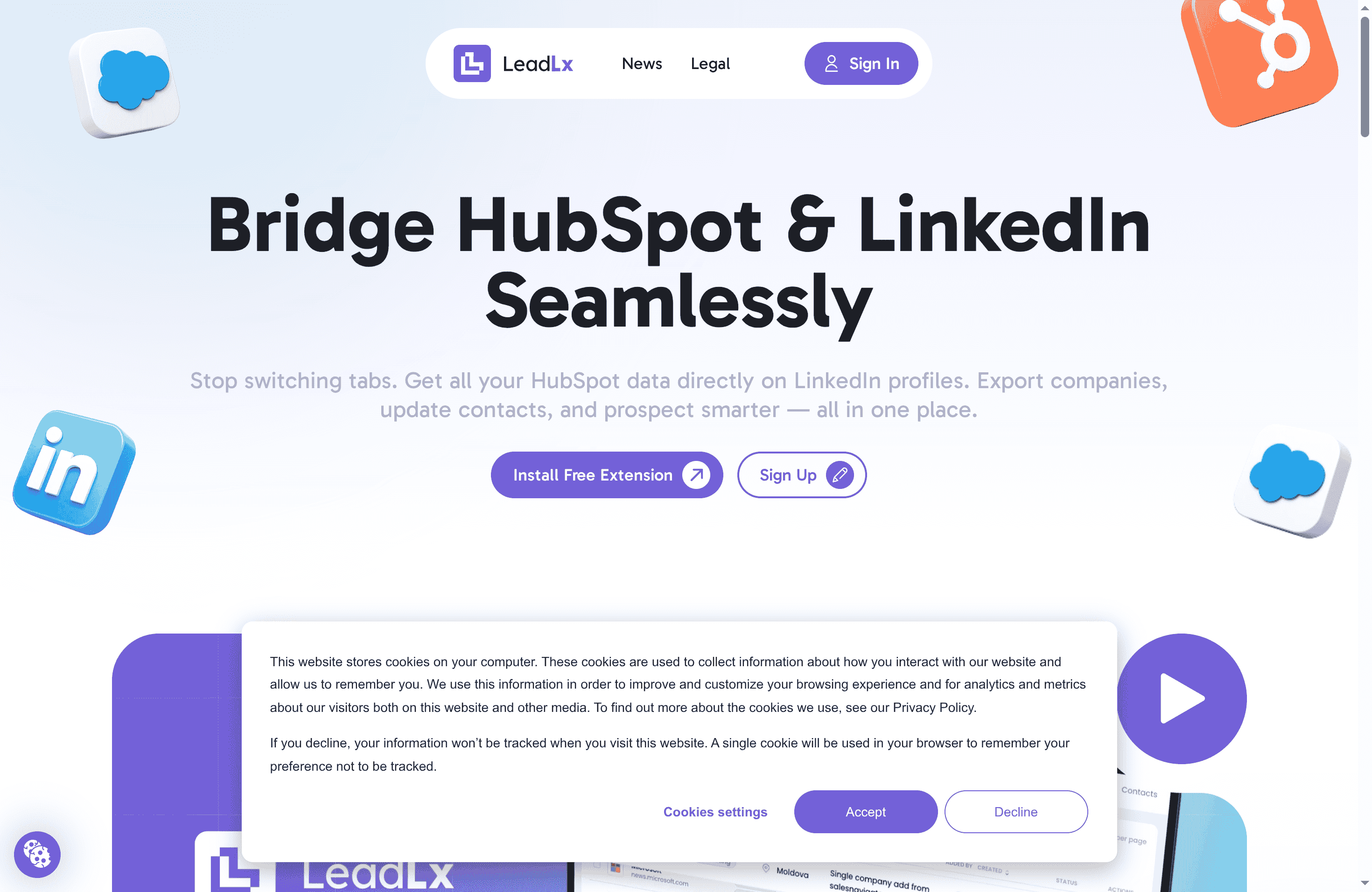
Simplify your outreach and reclaim valuable time. Visit LeadLx now to discover how our integrated platform can transform your data extraction and CRM processes into a seamless, productive experience.
Frequently Asked Questions
What is contact data extraction?
Contact data extraction is a process of retrieving and collecting contact information from various digital sources such as websites, social media, and email archives to streamline sales and marketing workflows.
How do automated extraction tools work with LinkedIn and CRMs?
Automated extraction tools use sophisticated web scraping technologies to parse LinkedIn profiles and convert unstructured web content into organized datasets that can be integrated into CRM systems, enhancing data accuracy and usability.
What are the key benefits of using contact data extraction?
Key benefits include significant time savings in lead generation, improved data accuracy, enhanced targeting for marketing campaigns, reduced manual data entry errors, and faster sales cycle progression.
What are the legal considerations surrounding contact data extraction?
Legal considerations include obtaining user consent, adhering to data privacy regulations like GDPR and CCPA, maintaining transparent data practices, and respecting platform-specific terms of service to avoid potential legal challenges.