
Over 80 percent of American professionals say meaningful LinkedIn connections directly influence their career opportunities. Effective outreach on this platform goes far beyond sending a simple message. In the modern business world, knowing how to personalize each interaction can mean the difference between a missed chance and a valuable relationship. This guide unpacks the strategies and subtle details that set successful LinkedIn outreach apart, making your networking smarter and more impactful.
Key Takeaways
| Point | Details |
|---|---|
| Personalization is Essential | Tailoring connection requests and messages to individual recipients increases response rates and fosters meaningful engagement. |
| Strategic Targeting Improves Success | Utilizing innovative outreach techniques and segmenting your network leads to more effective professional interactions. |
| CRM Integration Enhances Efficiency | Integrating CRM systems with LinkedIn enables data-driven outreach and better tracking of communication history. |
| Avoid Common Mistakes | Generic messages and aggressive sales tactics can damage trust; focus on providing value in every interaction. |
Understanding LinkedIn Outreach Fundamentals
LinkedIn outreach represents a strategic approach to professional networking and business development through targeted, personalized communication on the platform. At its core, this practice involves connecting with potential clients, partners, or industry professionals by crafting meaningful digital interactions that go beyond generic connection requests. Professional networking requires understanding nuanced communication strategies that respect boundaries while creating genuine engagement.
Successful LinkedIn outreach hinges on several critical principles. First, personalization is paramount – establishing authentic value early ensures higher response rates. Sales professionals and business development teams must research potential connections thoroughly, demonstrating genuine interest in their background, achievements, and potential mutual opportunities. This means moving beyond templated messages and creating communication that feels individually tailored.
The most effective LinkedIn outreach strategies combine strategic targeting with human-centered communication. This involves understanding your audience’s professional goals, crafting messages that address specific pain points, and presenting clear value propositions. Authentic relationship building means treating each interaction as an opportunity for meaningful professional dialogue rather than a transactional sales pitch.
Pro Tip for LinkedIn Networking: Always customize your connection request with a specific, relevant comment that shows you’ve reviewed the recipient’s profile and genuinely understand their professional context.
Types of LinkedIn Outreach Strategies
LinkedIn outreach encompasses a diverse range of strategic approaches designed to help professionals build meaningful connections and drive business opportunities. These strategies are not one-size-fits-all but require careful customization based on specific goals, target audiences, and industry dynamics. Networking strategies on LinkedIn can be broadly categorized into several key methodologies that enable targeted professional engagement.
One powerful approach involves innovative outreach techniques that go beyond traditional connection requests. These include trigger-based outreach, which involves reaching out to professionals during significant career milestones or company events, and group mining, where professionals strategically engage with members of specific industry or professional groups. Advanced methods like AI-powered video messaging and content seeding can also dramatically improve connection and response rates by providing more personalized, dynamic interaction modes.
The most effective LinkedIn outreach strategies typically blend multiple approaches. This might involve combining direct messaging with thoughtful content sharing, participating in relevant professional discussions, and leveraging mutual connections. Sales professionals and business development teams often use a multi-channel strategy that includes personalized connection requests, targeted content engagement, and strategic follow-up communications. The key is maintaining a balance between professional persistence and respectful communication.
Pro Tip for LinkedIn Strategy: Create a targeted outreach workflow that segments your network into specific personas and tailors communication approaches for each group, ensuring more personalized and effective professional interactions.
Here’s a comparison of common LinkedIn outreach strategies and their unique benefits:
| Outreach Strategy | Description | Typical Benefit |
|---|---|---|
| Trigger-Based Outreach | Engage during key events or milestones | Higher relevance and response |
| Group Mining | Connect via industry group interaction | Builds credibility through common interest |
| AI-Powered Video Messaging | Send personalized video introductions | Creates stronger engagement |
| Content Seeding | Share targeted content to spark dialogue | Positions user as an industry resource |
How CRM Integration Enhances Outreach
CRM integration transforms LinkedIn outreach from a scattered approach to a systematic, data-driven strategy that empowers sales and marketing professionals to optimize their networking efforts. By seamlessly connecting LinkedIn interactions with customer relationship management systems, teams can create a comprehensive view of prospect engagement, track communication history, and develop more intelligent outreach methodologies. Digital relationship management has evolved from manual tracking to sophisticated, integrated approaches that maximize professional networking potential.

Advanced CRM integration techniques enable businesses to streamline prospect interactions by automatically capturing and organizing contact information, interaction details, and engagement metrics. This approach eliminates manual data entry, reduces administrative overhead, and provides real-time insights into connection effectiveness. Sales teams can now leverage automated tracking that documents every touchpoint, from initial connection requests to follow-up communications, creating a holistic view of relationship development.
The most powerful CRM integrations go beyond simple data capture, offering intelligent personalization and strategic follow-up capabilities. By analyzing interaction histories, communication preferences, and professional backgrounds, these systems help professionals craft more targeted, relevant outreach messages. Marketing and sales teams can segment contacts more precisely, develop more nuanced communication strategies, and track the entire customer journey with unprecedented clarity. The result is a more efficient, data-informed approach to professional networking that dramatically improves connection and conversion rates.
Pro Tip for CRM Integration: Establish a standardized data capture and tagging protocol across your team to ensure consistent, high-quality contact information and interaction tracking in your CRM system.
Essential Steps for Effective Prospecting
Effective LinkedIn prospecting requires a strategic, methodical approach that transforms random networking attempts into purposeful professional connections. Success hinges on understanding that prospecting is not about volume, but about creating meaningful, targeted interactions with potential clients, partners, or industry peers. Professional networking demands precision, research, and a systematic methodology that goes beyond surface-level engagement.
Strategic prospecting techniques involve meticulously building a targeted network by identifying and connecting with professionals who align with specific business objectives. This means conducting thorough research on potential connections, understanding their professional background, recent achievements, and potential mutual interests. Successful prospectors craft personalized connection requests that demonstrate genuine interest, highlight shared professional contexts, and provide immediate value rather than generic, templated messages.
The most sophisticated prospecting strategies incorporate multi-layered communication approaches that blend personalization, timing, and strategic follow-up. This involves analyzing potential connections’ professional profiles, understanding their industry challenges, and developing outreach messages that speak directly to their specific needs or professional goals. Advanced practitioners leverage insights from LinkedIn profiles, shared connections, and professional content interactions to create highly targeted, contextually relevant communication that stands out in increasingly crowded digital networking environments.
Pro Tip for Prospecting: Develop a targeted outreach template that can be easily customized, allowing for quick personalization while maintaining a consistent, professional communication framework.
Common Risks and Mistakes to Avoid
LinkedIn outreach requires nuanced navigation, with numerous potential pitfalls that can derail professional networking efforts and damage potential relationship opportunities. Professional communication demands strategic awareness of common mistakes that can quickly undermine credibility and reduce connection success rates. Understanding these risks is crucial for developing a sophisticated, respectful approach to digital professional interactions.
Critical mistakes in LinkedIn outreach often stem from a lack of personalization and inappropriate communication strategies. Sales professionals frequently make errors like sending generic connection requests, using overly aggressive sales language, or failing to demonstrate genuine interest in the recipient’s professional context. These missteps can result in immediate rejection, blocked connections, or potential reputation damage within professional networks. Successful networkers understand that each interaction represents an opportunity to build meaningful professional relationships, not just secure an immediate transaction.
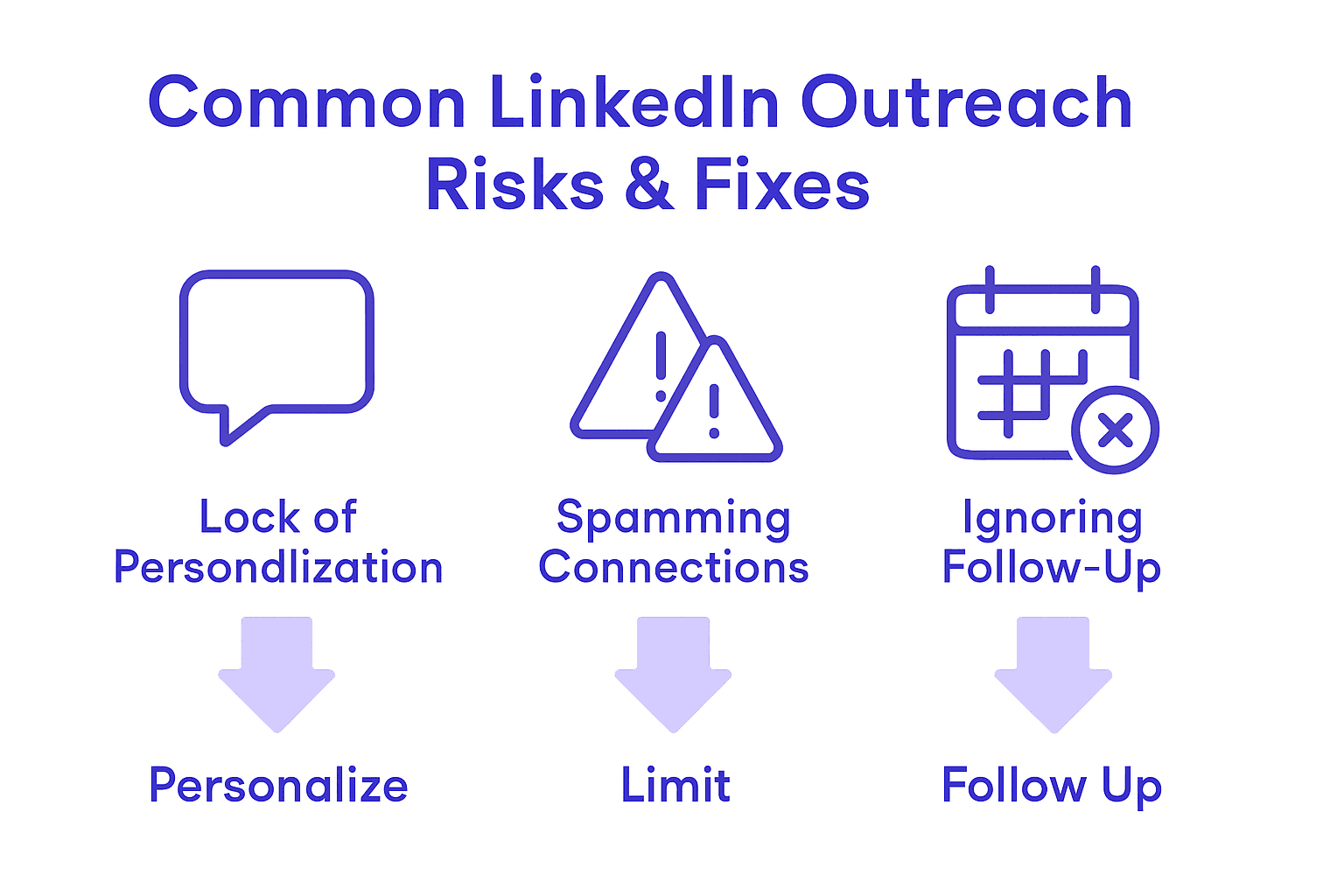
The most detrimental risks in LinkedIn outreach involve crossing professional boundaries and demonstrating a fundamental misunderstanding of networking etiquette. This includes sending unsolicited lengthy messages, making inappropriate connection requests to individuals outside one’s professional sphere, or repeatedly following up without providing clear value. Advanced practitioners recognize that effective networking requires a delicate balance between assertiveness and respect, carefully crafting messages that are concise, relevant, and demonstrate a genuine understanding of the recipient’s professional landscape. Successful outreach strategies prioritize quality of interaction over quantity of connections.
The table below summarizes key risks in LinkedIn outreach and effective ways to avoid them:
| Common Risk | Potential Impact | How to Avoid |
|---|---|---|
| Generic connection requests | Low response, damaged trust | Personalize every message |
| Overly aggressive sales pitches | Immediate rejection, blocks | Use consultative language |
| Messaging outside target audience | Reputation damage, wasted effort | Research recipients carefully |
| Excessive follow-up without value | Annoyance, broken connections | Provide clear, relevant benefit |
Pro Tip for Avoiding Risks: Develop a strict pre-send checklist for every LinkedIn message that evaluates personalization, value proposition, and professional tone before hitting send.
Streamline Your LinkedIn Outreach with LeadLx
The article highlights common challenges in LinkedIn outreach such as managing personalized communication, avoiding repetitive manual tasks, and maintaining accurate contact information. If you are struggling with integrating CRM data into your networking efforts or spending hours switching between LinkedIn and your CRM, you are not alone. Key pain points include inefficient prospecting workflows, lack of seamless data capture, and limited visibility for your team.
LeadLx directly addresses these issues by offering a powerful SaaS platform that overlays HubSpot or Salesforce data right onto LinkedIn profiles. This lets you instantly extract contact and company information from LinkedIn and update your CRM with a single click. By reducing manual data entry and preventing duplicate records, LeadLx enables you to save up to 10 hours every month while improving data accuracy and team collaboration. Discover how to transform your LinkedIn outreach with integrated prospecting tools designed to deliver personalized, timely, and effective engagement.
Experience how LeadLx can improve your professional networking and CRM integration today.
Take control of your LinkedIn prospecting workflow now with LeadLx. Visit our landing page to see how our platform can save you time, enhance your outreach personalization, and help you build stronger business relationships. Don’t let manual tasks slow down your sales and marketing teams – start optimizing your LinkedIn outreach with LeadLx today.
Frequently Asked Questions
What is LinkedIn outreach?
LinkedIn outreach is a strategic approach to professional networking and business development through targeted and personalized communication on the LinkedIn platform.
Why is personalization important in LinkedIn outreach?
Personalization is crucial because tailored messages demonstrate genuine interest in a recipient’s background and goals, leading to higher response rates and more meaningful connections.
What are some effective LinkedIn outreach strategies?
Effective strategies include trigger-based outreach, group mining, AI-powered video messaging, and shared content seeding, all of which enhance engagement and connection rates.
How does CRM integration improve LinkedIn outreach?
CRM integration streamlines networking efforts by organizing interaction data, enabling personalized communication, and providing insights that help tailor outreach strategies.