
Every American or Canadian sales professional knows the pain of pulling up a LinkedIn lead only to discover outdated job titles or missing contact details. When inaccurate information slows down lead generation in HubSpot or Salesforce, entire pipelines suffer. Focusing on improving data quality—accuracy, completeness, and consistency—enables teams to spend less time on tedious manual tasks and more time connecting with real prospects ready to buy.
Key Takeaways
| Point | Details |
|---|---|
| Data Quality is Essential | High-quality sales data ensures accuracy, completeness, and consistency, which directly impacts strategic decision-making. |
| Address Integration Challenges | Overcome complexities associated with using first, second, and third-party data through robust validation and governance protocols. |
| Implement Continuous Maintenance | Establish regular audits and a culture of data stewardship to maintain and improve data quality over time. |
| Recognize the Cost of Poor Data | Poor sales data quality can lead to significant revenue loss and operational inefficiencies; measures must be taken to mitigate these risks. |
What Is Data Quality for Sales Teams
Data quality represents the foundational measurement of how well sales team data meets established performance and operational standards. When sales professionals talk about data quality, they refer to information that is accurate, complete, consistent, and actionable across their customer relationship management (CRM) systems. Data quality dimensions include several critical aspects that determine its overall reliability and usefulness.
For sales teams, high-quality data means having contact details, company information, interaction histories, and prospect insights that are precise and current. This involves eliminating duplicate entries, correcting outdated information, and ensuring that every record provides meaningful context for sales interactions. The goal is creating a single source of truth that enables more targeted prospecting, personalized communication, and strategic decision making.
Practically speaking, maintaining data quality requires systematic processes like regular data audits, validation checks, and standardized data entry protocols. Sales professionals must implement tools and workflows that automatically clean, update, and verify information from multiple sources. By reducing manual data management and minimizing human error, teams can focus more energy on building relationships and closing deals rather than wrestling with inconsistent records.
Pro tip: Implement a monthly data hygiene routine where team members spend 30 minutes reviewing and updating their CRM contacts to maintain high-quality sales intelligence.
Types of Sales Data and Key Challenges
Sales teams work with multiple types of data that each play a critical role in driving business intelligence and strategic decision making. First-party data comes directly from customer interactions within CRM systems, including contact details, purchase histories, and communication logs. Data collection strategies reveal that organizations typically leverage three primary data categories: first-party, second-party, and third-party information, each presenting unique opportunities and challenges.
Second-party data involves information obtained through strategic partnerships, while third-party data is aggregated from external sources like market research firms and public databases. These different data types introduce complex integration challenges, requiring sales teams to develop sophisticated approaches for validation, cleaning, and strategic utilization. The complexity increases when considering privacy regulations, data accuracy requirements, and the need for consistent, meaningful insights across multiple information sources.
Here is a summary of sales data types and their main challenges:
| Data Type | Example Data | Key Challenge |
|---|---|---|
| First-Party | CRM interactions | Data accuracy and entry |
| Second-Party | Partner-shared lists | Integration difficulties |
| Third-Party | Market research data | Validation and relevance |
Navigating these challenges demands robust data management strategies. Sales professionals must implement advanced data governance protocols that address critical issues like duplicate entries, outdated information, inconsistent formatting, and potential security vulnerabilities. Effective data management involves not just collecting information, but creating systematic processes for continuous verification, updating, and strategic analysis that transform raw data into actionable business intelligence.
Pro tip: Create a quarterly data audit checklist that systematically reviews data sources, validates information accuracy, and identifies potential integration or quality issues across your sales intelligence platforms.
Characteristics of High-Quality Sales Data
Sales teams require comprehensive data attributes that transform raw information into strategic business intelligence. Data quality dimensions reveal six fundamental characteristics that define exceptional sales data: accuracy, completeness, consistency, timeliness, uniqueness, and accessibility. These characteristics ensure that every record provides meaningful insights and supports critical decision-making processes.
Accuracy means each data point reflects the true state of information, free from errors or misleading entries. Completeness ensures all necessary details are present, eliminating gaps that could compromise strategic planning. Consistency demands uniform data representation across different systems and sources, preventing contradictory information that could undermine sales strategies. Timeliness guarantees that information remains current and relevant, reflecting the most recent interactions and market dynamics.

Uniqueness prevents duplicate entries that can distort analytics and waste valuable time, while accessibility ensures authorized team members can readily retrieve and utilize critical information. Sales professionals must implement rigorous validation protocols that continuously monitor these data quality dimensions. This involves creating systematic processes for data cleansing, regular audits, and establishing clear governance standards that maintain the integrity of sales intelligence platforms.
Pro tip: Develop a monthly data quality scorecard that tracks and grades each of these six critical characteristics, providing your team with a clear, quantifiable approach to maintaining high-performance sales data.
Below is a quick reference for top data quality metrics and their business impact:
| Metric | Sales Impact | Common Monitoring Method |
|---|---|---|
| Accuracy | Improves close rates | Regular spot checks |
| Completeness | Enables campaign targeting | Automated completeness audit |
| Consistency | Eases reporting | Format validation script |
| Timeliness | Boosts sales agility | Timestamp field tracking |
| Uniqueness | Reduces wasted effort | Duplicate scan tool |
| Accessibility | Accelerates workflows | Access log review |
Common Data Quality Issues in CRM Integration
CRM integration challenges can significantly undermine sales team performance, creating hidden obstacles that prevent effective data management. CRM project failures often stem from critical data quality issues that compromise the entire system’s reliability. The most prevalent problems include inaccurate data entry, record duplication, inconsistent formatting, and incomplete contact information that create substantial roadblocks for sales professionals.
Specifically, sales teams encounter multiple complex data quality challenges. These include outdated contact details that render communication ineffective, misaligned data formats across different platforms, and incomplete records that lack critical context for meaningful customer interactions. Inconsistent data categorization means sales representatives waste valuable time manually reconciling information instead of focusing on revenue-generating activities. Some organizations discover that up to 30% of their CRM data becomes obsolete or inaccurate within a single year, creating significant strategic limitations.
Addressing these integration challenges requires a comprehensive approach that combines technological solutions with systematic organizational processes. Sales teams must implement robust data validation protocols, establish clear data entry standards, and create ongoing training programs that emphasize the importance of maintaining high-quality, accurate information. Automated data cleansing tools, regular manual audits, and cross-departmental collaboration can help mitigate these persistent data quality issues and restore trust in CRM systems.
Pro tip: Implement a quarterly data health check that involves randomly sampling 10% of your CRM records to assess accuracy, completeness, and consistency across all entries.
Risks and Costs of Poor Sales Data Quality
Sales organizations face substantial financial and operational risks when managing low-quality data. Data quality challenges can create devastating consequences that extend far beyond simple administrative inconveniences. Poor data integrity leads to significant revenue losses, with some estimates suggesting organizations lose between 15% to 25% of their annual revenue due to ineffective data management and decision-making based on unreliable information.
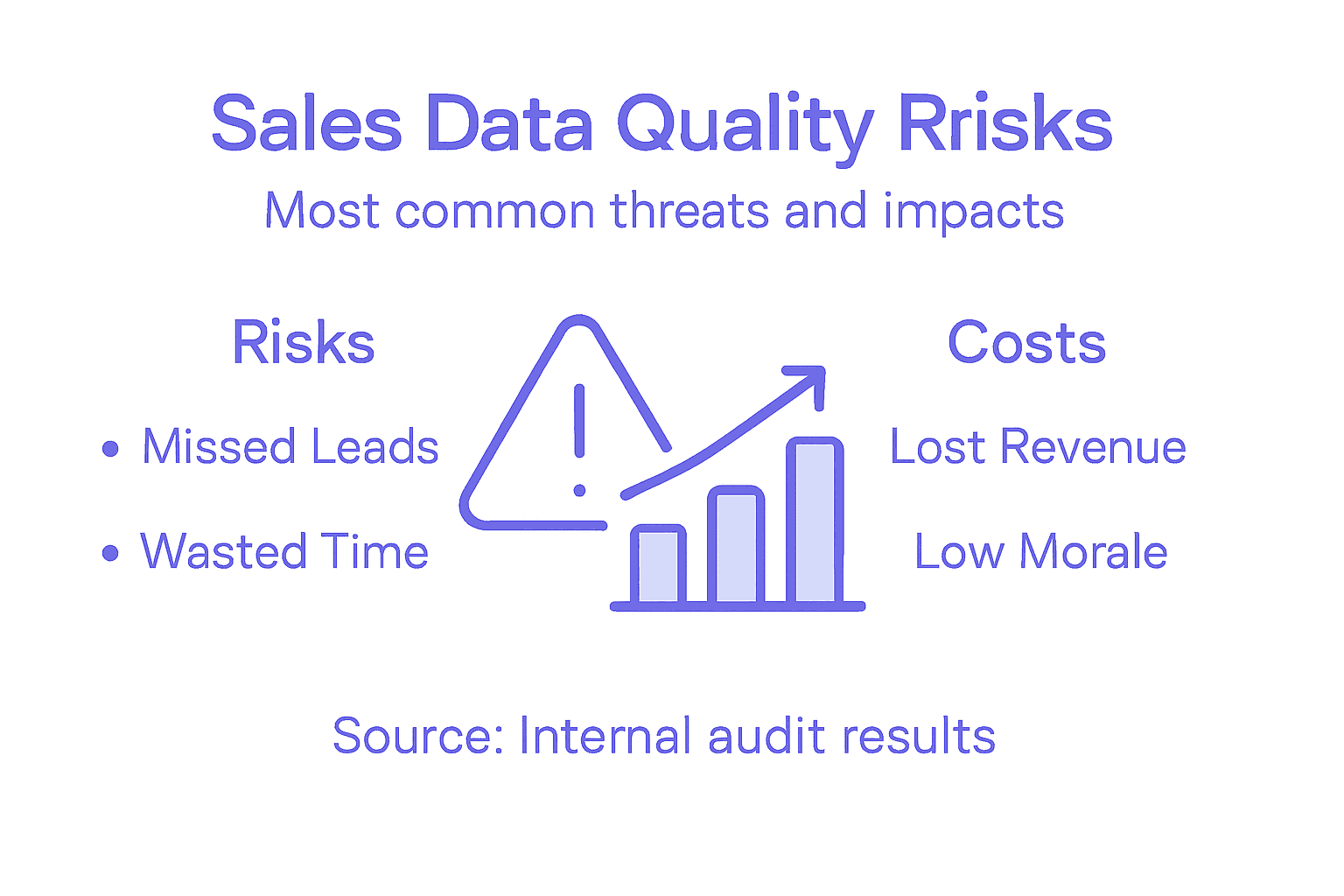
The most critical risks include compromised strategic planning, diminished customer engagement, and reduced operational efficiency. Inaccurate sales data can cause multiple downstream problems such as misguided marketing campaigns, incorrect sales forecasting, and ineffective lead targeting. Sales teams might invest resources pursuing unqualified leads or miss potential opportunities because of incomplete or incorrect contact information. These errors translate into tangible financial losses, with wasted time, reduced productivity, and missed revenue potential.
Beyond immediate financial impacts, poor data quality undermines long-term organizational competitiveness. Sales teams relying on inconsistent data experience decreased trust in their internal systems, reduced collaboration between departments, and slower response times to market changes. The compounding effect of these challenges can create a cascading negative impact that gradually erodes an organization’s ability to make strategic decisions, ultimately threatening its market position and growth potential.
Pro tip: Conduct a comprehensive data quality audit quarterly, tracking metrics like record completeness, accuracy rates, and potential revenue impact to proactively identify and address data management weaknesses.
Best Practices for Maintaining Accurate Sales Data
Maintaining high-quality sales data requires a strategic and comprehensive approach that integrates technological solutions with organizational processes. Data validation techniques are fundamental to ensuring that every piece of information entering the system meets rigorous accuracy standards. This involves implementing robust validation rules at the point of data entry, creating automatic checks that prevent incomplete or incorrect information from contaminating the sales database.
Successful data maintenance relies on multiple interconnected strategies. Sales teams must develop standardized data collection protocols that ensure consistent formatting, eliminate redundant entries, and create clear guidelines for data input. This includes establishing uniform naming conventions, contact information structures, and categorization methods that reduce human error and streamline information management. Automated data cleansing tools can help identify and remove duplicate records, outdated information, and inconsistent entries, maintaining the overall health of the sales intelligence platform.
Building a data-quality culture within the organization is equally critical. This means providing comprehensive training for sales representatives, creating accountability mechanisms, and fostering an understanding that data quality is a shared responsibility. Regular audits, continuous monitoring of key data quality metrics, and creating feedback loops that allow team members to report and correct data discrepancies are essential components of a proactive data management strategy.
Pro tip: Designate a quarterly data stewardship champion who reviews and reports on your team’s data quality metrics, creating transparency and driving continuous improvement in your sales data management practices.
Elevate Your Sales Data Quality with LeadLx
The article highlights the critical challenges sales teams face managing data quality issues like inaccurate entries, duplicates, and inconsistent formatting that undermine CRM effectiveness and sales productivity. If you want to overcome these pain points and align with best practices such as regular validation and eliminating manual data errors, adopting a seamless tool that integrates LinkedIn insights directly into your CRM workflow is essential. LeadLx is designed precisely to tackle these obstacles by streamlining data capture, improving accuracy, and saving precious time.

Experience a new level of sales intelligence with LeadLx, a SaaS platform that overlays HubSpot and Salesforce data onto LinkedIn profiles for instant access to clean, complete contact and company information. This solution helps you avoid duplicate entries through shared CRM visibility and automate timely updates with just one click. Don’t let poor data quality cost you deals or slow down your sales team. Visit LeadLx now to enhance your prospecting efficiency and turn your sales data into a powerful asset.
Frequently Asked Questions
What is data quality in sales teams?
Data quality in sales teams refers to the accuracy, completeness, consistency, timeliness, uniqueness, and accessibility of information within customer relationship management (CRM) systems. High-quality data enables effective sales interactions and strategic decision-making.
Why is maintaining data quality important for sales performance?
Maintaining data quality is crucial for sales performance because inaccurate or incomplete data can lead to misguided marketing efforts, incorrect sales forecasting, and inefficient lead targeting, ultimately resulting in lost revenue and reduced operational efficiency.
What are the main types of sales data, and what challenges do they present?
The main types of sales data include first-party data (from CRM interactions), second-party data (from strategic partnerships), and third-party data (from external sources). Challenges include data accuracy, integration difficulties, and ensuring data relevance across multiple platforms.
How can sales teams ensure high-quality data in their CRM systems?
Sales teams can ensure high-quality data by implementing regular data audits, standardizing data entry protocols, utilizing automated data cleansing tools, and fostering a culture of data quality awareness among team members.