
Nearly every American tech sales team faces hours lost to manual data entry and scattered prospecting efforts. When speed and precision matter, inefficient workflows can sabotage even the best strategies. By understanding what drives an efficient prospecting workflow, sales professionals in global tech companies using HubSpot or Salesforce can unlock smarter ways to maximize LinkedIn outreach and transform routine tasks into powerful, results-driven systems.
Key Takeaways
| Point | Details |
|---|---|
| Efficient Prospecting Workflows | Implementing a data-driven prospecting workflow enhances productivity by automating routine tasks and streamlining lead engagement. |
| LinkedIn and CRM Integration | A strategic integration process between LinkedIn and CRM systems enables seamless data capture and management, enhancing lead enrichment. |
| Modern Prospecting Tools | Utilizing advanced prospecting tools with AI capabilities allows for smarter lead scoring and personalized outreach, significantly improving conversion rates. |
| Avoiding Common Pitfalls | Recognizing and addressing common workflow pitfalls through systematic audits and best practices can boost sales team efficiency and effectiveness. |
What Makes a Prospecting Workflow Efficient
An efficient prospecting workflow transforms scattered sales activities into a strategic, data-driven system that maximizes productivity and minimizes wasted effort. At its core, such a workflow integrates intelligent automation, precise task prioritization, and seamless data management to streamline lead identification and engagement.
The foundation of an efficient prospecting workflow lies in its ability to break complex processes into repeatable, manageable steps. This means creating a structured approach that reduces cognitive load and eliminates unnecessary manual tasks. Sales professionals should focus on developing a systematic method that automates routine activities like contact logging, profile research, and initial outreach, allowing more time for high-value interactions that require human nuance and strategic thinking.
Key characteristics of an efficient prospecting workflow include:
- Automated data capture and CRM integration
- Clear lead qualification criteria
- Prioritized task management
- Collaborative communication tools
- Continuous performance tracking and optimization
These elements work together to create a dynamic system that adapts to changing sales landscapes while maintaining consistent performance. Successful workflows leverage technology to reduce manual data entry, provide real-time insights, and enable team collaboration without sacrificing the personalized touch that drives meaningful customer relationships.
Pro Tip: Implement a 15-minute daily review of your prospecting workflow to identify bottlenecks, refine processes, and ensure continuous improvement of your sales strategy.
Key Steps for LinkedIn and CRM Integration
Successful LinkedIn and CRM integration requires a strategic approach that transforms disconnected data sources into a unified, powerful sales ecosystem. The goal is to create a seamless workflow that automatically captures, manages, and enriches lead information with minimal manual intervention.

The integration process begins with understanding the specific data synchronization requirements between LinkedIn and your CRM platform. This typically involves several critical steps: obtaining administrative access to both systems, configuring sync settings, and establishing precise data mapping protocols. Sales teams must ensure they have a LinkedIn Sales Navigator account and the necessary CRM permissions to enable comprehensive data transfer and automation.
Key technical steps for effective LinkedIn and CRM integration include:
- Verify administrative access credentials
- Configure LinkedIn data sync settings
- Map contact and company data fields
- Set up automated lead capture workflows
- Establish data privacy and compliance checks
- Test and validate data transfer mechanisms
Beyond technical implementation, successful integration demands a strategic approach to data management. This means creating workflows that not only transfer information but also provide actionable insights. Modern integration solutions enable automatic lead profile enrichment, real-time activity tracking, and intelligent task assignment, transforming raw contact data into strategic sales intelligence.
Pro Tip: Schedule a quarterly review of your LinkedIn CRM integration settings to ensure ongoing data accuracy and alignment with evolving sales strategies.
Essential Features of Modern Prospecting Tools
Modern prospecting tools have evolved from simple contact databases to sophisticated intelligence platforms that transform how sales teams identify, engage, and convert potential customers. These advanced solutions leverage cutting-edge technologies to streamline the entire sales prospecting process, making traditional manual research methods increasingly obsolete.
Artificial intelligence and data-driven insights have become fundamental components of contemporary prospecting technologies, enabling sales teams to move beyond generic outreach strategies. These tools now offer sophisticated capabilities such as AI-powered lead scoring, predictive analytics, and hyper-personalized engagement recommendations that dramatically improve conversion potential.
Key features of modern prospecting tools include:
- Comprehensive contact and decision-maker databases
- Multi-channel outreach support (email, phone, social media)
- Automated lead qualification and scoring mechanisms
- Real-time company and contact enrichment
- Advanced filtering and segmentation capabilities
- Seamless CRM integration
- Performance tracking and analytics dashboards
Beyond technical capabilities, the most effective prospecting tools provide actionable intelligence that transforms raw data into strategic insights. They enable sales professionals to understand not just who to contact, but precisely when and how to engage with maximum potential for success. This shift from volume-based to intelligence-driven prospecting represents a fundamental transformation in sales engagement strategies.
Here’s a summary of how modern prospecting tools enhance sales workflow efficiency:
| Feature Area | Traditional Methods | Modern Prospecting Tools | Business Impact |
|---|---|---|---|
| Data Entry | Manual, time-consuming | Automated, real-time sync | Saves hours weekly |
| Lead Scoring | Subjective, inconsistent | AI-powered, data-driven | Boosts conversion rates |
| Outreach Strategy | Generic bulk emails | Personalized multi-channel campaigns | Improves engagement rates |
| Insights and Analytics | Basic tracking | Advanced dashboards, predictive analytics | Better decision making |
Pro Tip: Evaluate prospecting tools not just by their feature list, but by their ability to reduce manual research time and improve targeted engagement precision.
Real-World Applications in Tech Sales Teams
Tech sales teams operate in an increasingly complex and competitive landscape that demands sophisticated, data-driven prospecting strategies. Gone are the days of generic cold calling and scattered lead generation approaches. Modern technology companies require precision, efficiency, and intelligent targeting to break through the noise and connect with high-potential prospects.
Tech sales organizations are rapidly transforming their prospecting workflows by leveraging AI and automation technologies, fundamentally reshaping how they identify, engage, and convert potential customers. This technological evolution allows sales teams to move beyond traditional manual research methods, creating more strategic and intelligent outreach processes that dramatically improve conversion rates and sales cycle efficiency.
Typical real-world applications for advanced prospecting technologies in tech sales teams include:
- Predictive lead scoring and prioritization
- Automated personalized outreach campaigns
- Real-time market and company intelligence gathering
- Dynamic territory and account targeting
- Intelligent contact and decision-maker identification
- Streamlined sales pipeline management
- Performance analytics and continuous optimization
Successful implementation of these technologies requires more than just tool adoption. Tech sales teams must develop a holistic approach that integrates advanced prospecting platforms with their existing sales methodologies, ensuring that human creativity and strategic thinking remain at the core of their engagement strategies. The most effective teams view these technologies as collaborative tools that augment human capabilities rather than replace them.
Pro Tip: Conduct a quarterly audit of your prospecting technology stack to ensure alignment with evolving sales strategies and emerging market opportunities.
Common Workflow Pitfalls and How to Avoid Them
Prospecting workflows are complex ecosystems where seemingly minor inefficiencies can dramatically undermine sales team performance. Without strategic intervention, sales professionals often find themselves trapped in repetitive, low-value activities that consume significant time and energy without producing meaningful results.
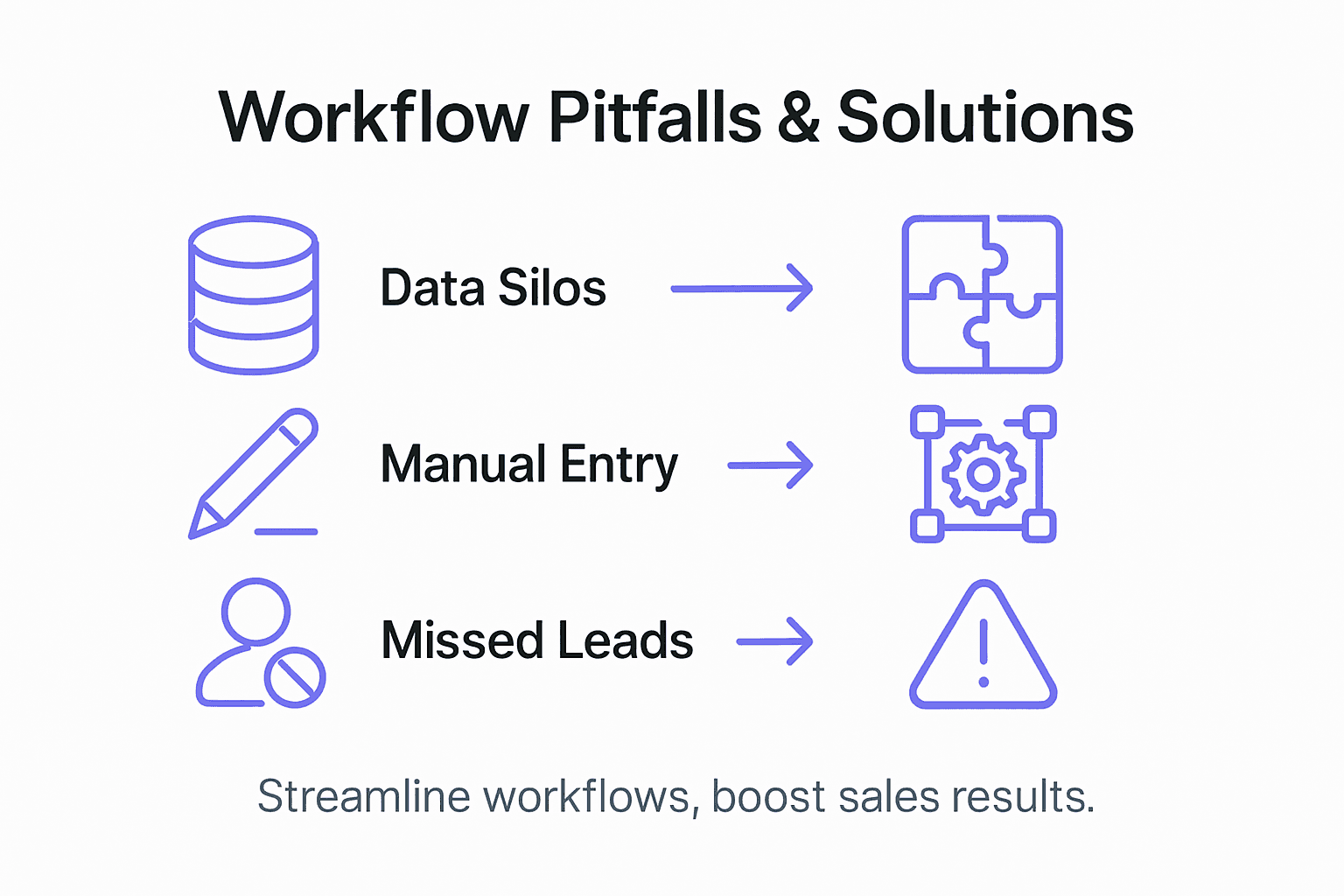
Sales teams frequently encounter critical challenges that can derail their prospecting effectiveness, ranging from lead quality identification to inefficient engagement strategies. Understanding these potential pitfalls is the first step toward developing a robust, adaptable prospecting approach that maximizes both efficiency and conversion potential.
Common workflow pitfalls that sales teams must proactively address include:
- Inconsistent lead qualification criteria
- Lack of systematic lead scoring mechanisms
- Manual data entry and research processes
- Inadequate cross-team communication
- Poorly defined ideal customer profiles
- Reactive instead of proactive engagement strategies
- Overlooking data privacy and compliance requirements
Successful sales organizations recognize that avoiding these pitfalls requires more than technological solutions. It demands a holistic approach that combines advanced tools, strategic thinking, and continuous process refinement. By developing adaptive workflows that leverage intelligent automation while maintaining human insight, sales teams can transform potential obstacles into opportunities for meaningful engagement and accelerated growth.
Compare common workflow pitfalls with best practices for optimized prospecting:
| Common Pitfall | Consequence | Best Practice | Positive Outcome |
|---|---|---|---|
| Inconsistent lead criteria | Missed qualified prospects | Standardized scoring framework | Higher quality pipeline |
| Manual data entry | Time wasted, errors | Automated CRM integration | Accurate, timely data |
| Poor communication | Duplicate outreach | Collaborative tools | Unified team efforts |
| Reactive follow-up | Lost opportunities | Proactive engagement plan | Increased win rate |
Pro Tip: Implement a monthly workflow audit that systematically evaluates your prospecting process, identifying bottlenecks and testing incremental improvements.
Boost Your Prospecting Efficiency with LinkedIn CRM Integration
If you found the detailed strategies on building an efficient prospecting workflow insightful, it’s time to eliminate the common pain points of manual data entry and fragmented LinkedIn-CRM processes. Sales and marketing teams often struggle with repetitive tasks, inconsistent lead qualification, and context switching between platforms. These challenges slow down productivity and increase the risk of errors.
LeadLx solves these exact hurdles by seamlessly integrating LinkedIn with top CRM tools like HubSpot and Salesforce. With features such as instant contact and company data extraction, one-click CRM updates, and a browser extension that overlays CRM data directly on LinkedIn profiles, it transforms complex workflows into streamlined, time-saving routines. This means you spend less time on administrative tasks and more time on meaningful engagement and strategic selling.
Ready to reclaim 10 hours per week and enhance your prospecting accuracy today Discover how LeadLx can supercharge your LinkedIn CRM integration at LeadLx. Start optimizing your sales workflows now and experience smoother prospecting with smarter technology. Explore all the details on how to streamline your process here and see why sales teams rely on LeadLx for better data accuracy and collaboration.
Frequently Asked Questions
What are the key characteristics of an efficient prospecting workflow?
An efficient prospecting workflow includes automated data capture and CRM integration, clear lead qualification criteria, prioritized task management, collaborative communication tools, and continuous performance tracking and optimization.
How can LinkedIn and CRM integration enhance my prospecting strategy?
Integrating LinkedIn with your CRM provides a seamless workflow that automatically captures, manages, and enriches lead information. This reduces manual intervention and allows for real-time insights, increasing the efficiency of your sales outreach.
What are the common pitfalls to avoid in prospecting workflows?
Common pitfalls include inconsistent lead qualification criteria, manual data entry, inadequate communication, poorly defined ideal customer profiles, and reactive engagement strategies. Addressing these issues can enhance prospecting efficiency.
What should I regularly review in my prospecting workflow?
It’s advised to conduct a regular review of your prospecting workflow to identify bottlenecks, refine processes, and ensure that your strategies align with evolving sales objectives.