
Over half of American sales professionals say manual prospect data entry drains time and weakens focus. The quest for seamless, accurate LinkedIn prospecting has become urgent as real-time engagement now sets the winners apart. With demand for precision and efficiency rising in every American sales team, this article highlights practical ways to transform workflows, automate data sync, and increase conversion potential—all while keeping accuracy at the core of your HubSpot or Salesforce process.
Key Takeaways
| Point | Details |
|---|---|
| Emphasis on Real-Time Data | Modern sales prospecting relies on real-time data to identify and engage leads quickly, improving conversion rates significantly. |
| LinkedIn-CRM Integration Benefits | Integrating LinkedIn with CRM systems streamlines data management and enhances engagement strategies through predictive analytics and lead scoring. |
| Automated Workflows Enhance Productivity | Real-time workflows and AI-powered sales automation reduce manual errors and increase team efficiency, enabling targeted outreach and faster responses. |
| Importance of Timely Engagement | Delayed engagement can lead to significant revenue loss; thus, implementing automated responses is crucial for maintaining prospects’ interest. |
Defining Real-Time Prospecting in Modern Sales
Sales prospecting has undergone a profound transformation in the digital age, moving far beyond traditional cold calling techniques. Modern sales prospecting now leverages digital platforms and data-driven insights to identify and engage high-potential leads with unprecedented precision and speed.
Real-time prospecting represents a strategic approach where sales professionals utilize immediate, actionable data to connect with potential customers at the most opportune moments. Unlike historical methods that relied on static contact lists and generalized outreach, this modern technique integrates advanced technologies like artificial intelligence and real-time analytics to pinpoint prospects with laser-focused accuracy. The core objective is transforming raw data into meaningful engagement opportunities that can accelerate the sales conversion process.
The fundamental components of real-time prospecting include instantaneous lead identification, behavioral tracking, personalized communication strategies, and dynamic prospect scoring. Sales teams now have access to tools that provide instant insights into a potential customer’s online activities, professional interactions, and demonstrated interests. This enables representatives to craft highly targeted approaches that resonate more effectively than traditional one-size-fits-all communication methods.
Here’s a summary of how real-time prospecting compares to traditional prospecting methods:
| Aspect | Traditional Prospecting | Real-Time Prospecting |
|---|---|---|
| Data Source | Static contact lists | Live, actionable data |
| Lead Identification | Manual, time-consuming | Automated, instant |
| Personalization | Generic scripts | Custom, targeted messaging |
| Response Time | Delayed follow-ups | Immediate engagement |
| Conversion Likelihood | Lower due to slow response | Higher with timely response |
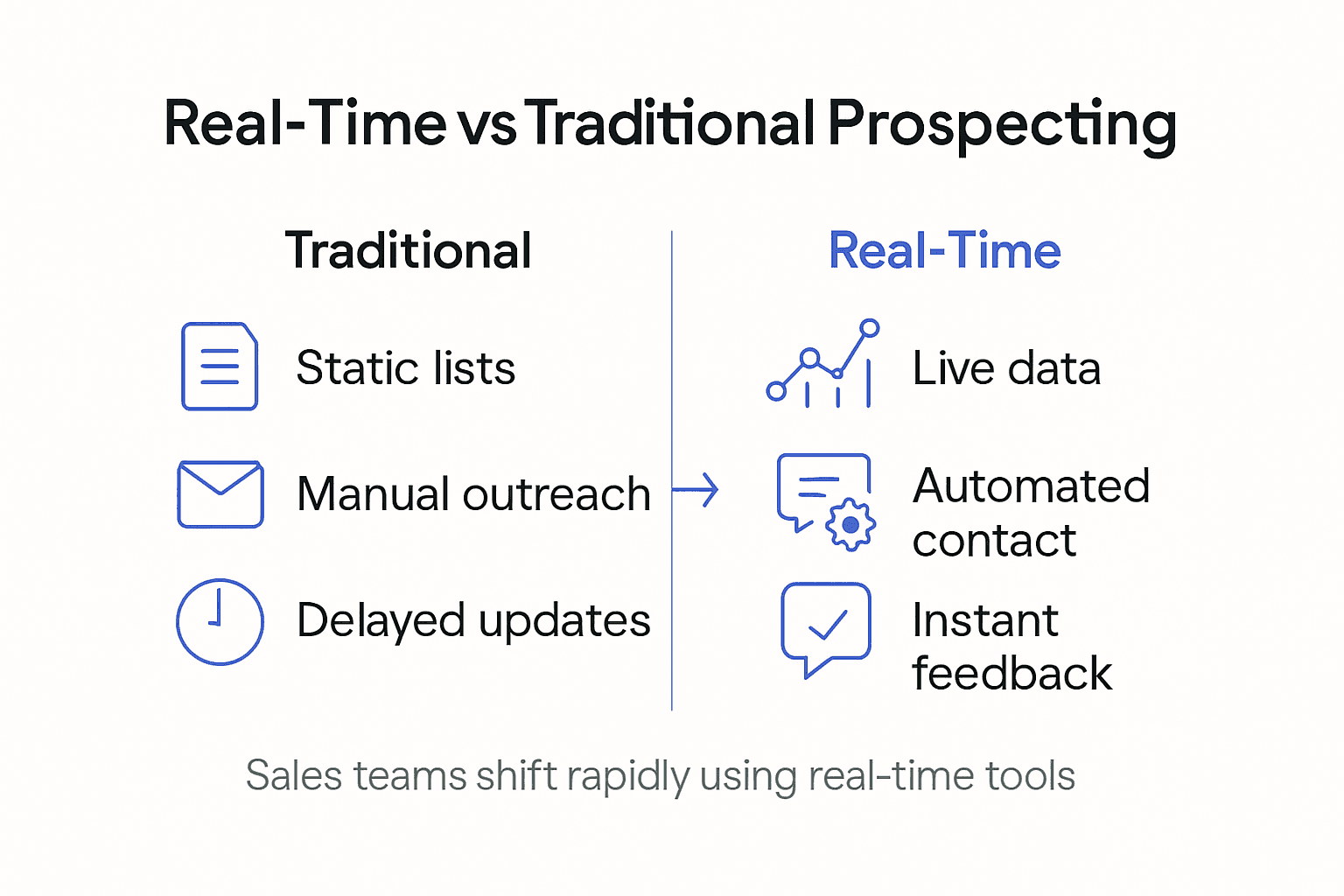
Pro Tip: Implement a real-time prospect tracking system that integrates multiple data sources to create a comprehensive view of potential leads before initial contact.
How LinkedIn-CRM Integration Accelerates Prospecting
LinkedIn-CRM integration represents a transformative approach for sales teams seeking to optimize their prospecting strategies. Integrating LinkedIn with CRM systems automates critical data synchronization processes, enabling sales professionals to capture and manage prospect information with unprecedented efficiency and accuracy.
The core advantage of this integration lies in its ability to eliminate manual data entry and provide real-time insights into potential customer profiles. Sales representatives can now access comprehensive professional information directly within their CRM platform, reducing time spent switching between multiple tools and minimizing the risk of data entry errors. This seamless connection allows teams to instantly transfer LinkedIn profile details, contact information, and professional backgrounds into their primary sales tracking system, creating a more dynamic and responsive prospecting workflow.

Modern LinkedIn-CRM integration technologies offer advanced features that go beyond simple data transfer. These sophisticated systems employ artificial intelligence and machine learning algorithms to score leads, track engagement patterns, and provide predictive analytics about potential customer interactions. By combining the rich professional network data from LinkedIn with the robust tracking capabilities of CRM platforms, sales teams can develop more targeted, personalized outreach strategies that significantly improve conversion rates and reduce overall prospecting time.
Consider these advanced features of LinkedIn-CRM integration and their impact on sales performance:
| Feature | How It Works | Impact on Sales |
|---|---|---|
| Automated Data Sync | Transfers contact info instantly | Minimizes errors and saves time |
| Lead Scoring AI | Ranks prospects by potential | Prioritizes high-value leads |
| Engagement Tracking | Monitors interactions across platforms | Enhances follow-up strategy |
| Predictive Analytics | Analyzes historical data for trends | Increases conversion rates |
Pro Tip: Configure automatic lead scoring and tracking rules in your CRM to prioritize LinkedIn connections that match your ideal customer profile with the highest precision.
Key Features That Enable Real-Time Workflows
AI-powered sales automation workflows transform traditional prospecting methods by introducing unprecedented speed and intelligent responsiveness into sales processes. These advanced technologies leverage real-time data processing to create dynamic, adaptive engagement strategies that fundamentally reshape how sales teams identify, track, and interact with potential customers.
The core features enabling real-time workflows center around intelligent automation and instantaneous information processing. Modern sales platforms integrate sophisticated tools like automated lead scoring, predictive analytics, and behavior tracking algorithms that continuously analyze prospect interactions. These systems can instantly prioritize leads based on engagement signals, professional attributes, and historical conversion patterns, allowing sales representatives to focus their energy on the most promising potential customers with remarkable precision.
Critical workflow enablement features include omnichannel communication tracking, seamless team collaboration interfaces, and AI-driven insights that provide contextual recommendations. Sales teams can now receive instant notifications about prospect activities, track communication histories across multiple platforms, and access comprehensive contact profiles that update in real time. These capabilities eliminate traditional information silos, creating a unified, responsive ecosystem where sales professionals can make data-driven decisions with unprecedented speed and accuracy.
Pro Tip: Configure your sales automation tools to create custom trigger-based workflows that automatically route high-potential leads to the most appropriate sales representative based on specific qualification criteria.
The Impact on Team Productivity and Data Accuracy
Cutting-edge technologies combined with effective team management significantly transform sales team performance, creating unprecedented opportunities for productivity and data precision. By implementing real-time workflows, organizations can dramatically reduce manual errors, streamline communication, and create a more responsive and intelligent sales environment.
The primary productivity gains emerge from automated data synchronization and intelligent information routing. Sales teams no longer waste hours manually entering contact information or tracking down scattered communication threads. Instead, advanced systems automatically capture, validate, and distribute critical prospect data across platforms, ensuring that every team member has access to the most current and accurate information. This approach eliminates redundant data entry, reduces human error, and creates a single source of truth that enables faster, more confident decision making.
Real-time data analytics provide managers with granular insights into team performance, enabling proactive coaching and strategic resource allocation. By continuously monitoring key performance indicators, team leaders can identify potential bottlenecks, recognize top performers, and quickly adjust workflows to maximize overall effectiveness. The ability to track engagement metrics, response times, and conversion rates in real time transforms traditional management approaches from reactive to predictive, allowing for immediate interventions and continuous performance optimization.
Pro Tip: Implement a weekly team dashboard review that highlights real-time productivity metrics, focusing on data accuracy and collaborative performance to drive continuous improvement.
Common Pitfalls of Delayed Prospect Engagement
Delayed prospect engagement represents a critical vulnerability in modern sales strategies, creating significant missed opportunities that can dramatically impact revenue potential. Outbound prospecting requires swift, strategic responses to maintain competitive momentum and prevent potential leads from cooling or shifting their attention to alternative solutions.
The most substantial risks of delayed engagement emerge through several interconnected challenges. First, potential customers quickly lose interest when sales representatives fail to respond promptly, with research indicating that response times exceeding 24 hours can reduce conversion probabilities by up to 60%. Prospects in competitive markets are simultaneously evaluating multiple solutions, and their decision-making window is increasingly compressed. Slow communication signals potential organizational inefficiency, potentially undermining the prospect’s confidence in a company’s ability to deliver responsive, high-quality services.
Additionally, delayed engagement creates a cascade of negative consequences across the sales ecosystem. Sales teams miss critical momentum in building relationships, lose the opportunity to shape early conversations, and allow competitors to potentially intervene and capture market share. The psychological impact of delayed communication cannot be understated: prospects interpret slow responses as a lack of genuine interest, professionalism, or organizational capability. Modern buyers expect immediate, personalized interactions that demonstrate understanding of their specific needs and challenges, making real-time responsiveness not just a preference, but an absolute requirement for successful sales engagement.
Pro Tip: Implement an automated lead response system that ensures initial contact occurs within 15 minutes of a prospect’s inquiry, dramatically increasing your chances of successful engagement.
Discover How Real-Time Prospecting Can Revolutionize Your Sales Workflow
The article highlights how delayed prospect engagement and manual data entry slow down sales teams and reduce conversion rates. If you struggle with switching between LinkedIn and your CRM or missing timely follow-ups on valuable leads, you are not alone. Real-time prospecting means breaking free from tedious manual tasks while gaining instant access to actionable data to engage prospects immediately and effectively.
LeadLx is designed precisely to conquer these challenges. With our browser extension seamlessly integrating LinkedIn with CRMs like HubSpot and Salesforce, you can extract contact details and update CRM records instantly without tab switching. This dramatically reduces errors, saves up to 10 hours weekly, and ensures you never lose momentum with your prospects. Features like bulk data extraction, shared CRM visibility, and automatic capture of company info empower your team to prioritize hot leads and avoid duplication.
Ready to transform your sales prospecting and capture leads the moment they show interest Visit LeadLx today to start improving your data accuracy and sales team productivity. Learn more about how our platform integrates LinkedIn and CRM at LeadLx Website and see why smarter prospecting drives higher conversion rates.
Frequently Asked Questions
What is real-time prospecting in sales?
Real-time prospecting is a modern sales strategy that uses immediate, actionable data to connect with potential customers at the most opportune moments. It helps sales teams identify and engage high-potential leads with precision.
How does real-time prospecting differ from traditional prospecting methods?
Unlike traditional prospecting methods that rely on static contact lists and generalized outreach, real-time prospecting utilizes live, actionable data for lead identification, allowing for personalized communication and faster response times.
What tools are used in real-time prospecting?
Real-time prospecting often involves tools that utilize artificial intelligence, data analytics, behavioral tracking, and CRM integration to provide sales teams with insights into potential customer interactions and preferences.
Why is timely engagement important for prospects?
Timely engagement is crucial because delayed responses can cause potential customers to lose interest significantly. Research indicates that response times greater than 24 hours can reduce conversion probabilities by up to 60%, impacting overall sales effectiveness.