
Nearly half of American sales teams report that inefficient data export slows down lead generation and drains valuable resources. In a global market where every minute counts, marketing professionals need seamless workflows to move contact information between LinkedIn and CRM systems. This guide breaks down practical strategies and highlights pitfalls, empowering you to enhance accuracy and efficiency while keeping your lead pipeline strong.
Key Takeaways
| Point | Details |
|---|---|
| Data Export Process | Data export involves extraction, transformation, and loading (ETL) to streamline lead management and enhance campaign targeting. |
| Manual vs. Automated Methods | Choosing between manual and automated data exports depends on dataset complexity and organizational resources, with automated methods offering higher efficiency. |
| CRM Integration with LinkedIn | Integrating LinkedIn data into CRM systems enriches contact profiles and automates data transfer, improving lead qualification strategies. |
| Data Accuracy and Compliance | Implement rigorous security measures and compliance protocols to mitigate risks associated with data exports and ensure data integrity. |
Defining Data Export in Marketing Workflows
Data export represents a critical process in modern marketing workflows that enables professionals to transfer, transform, and leverage valuable contact information across different systems. At its core, data export involves systematically extracting information from one platform and transferring it into another, allowing marketing teams to streamline their lead management and analysis processes.
The process typically encompasses three fundamental stages: extraction, transformation, and loading (ETL). When marketing teams export data from systems like customer databases, they can perform sophisticated segmentation, conduct deeper analysis, and optimize campaign targeting with unprecedented precision. This workflow ensures that raw contact details are converted into actionable intelligence that drives strategic decision making.
Marketing data export goes beyond simple file transfers. It involves carefully mapping data fields, maintaining data integrity, and ensuring compatibility between different technological platforms. Sales and marketing professionals use these exports to consolidate contact information, track lead interactions, and create more personalized outreach strategies. By standardizing data across multiple systems, teams can reduce manual entry errors, improve collaboration, and create a more unified view of potential customer interactions.
Pro Tip: Always validate your exported data against original sources to maintain accuracy and prevent potential communication breakdowns with potential leads.
Key Methods: Manual vs. Automated Export
Data export methods fundamentally split into two distinct approaches: manual and automated processes, each with unique strengths and limitations for marketing professionals. Manual export represents a traditional approach where team members directly extract and transfer data between systems, requiring significant human intervention and careful attention to detail.
Automated data workflows dramatically transform how marketing teams handle information, offering unprecedented efficiency and scalability. These technological solutions leverage advanced ETL (extract, transform, load) tools that can process massive datasets with minimal human interaction. Unlike manual methods, automated exports reduce human error, accelerate data processing, and enable consistent, repeatable data transfer across complex marketing ecosystems.
The choice between manual and automated export depends on several critical factors, including dataset complexity, organizational resources, and specific workflow requirements. Small teams or specialized projects might benefit from manual exports that allow granular control and nuanced data handling. Conversely, larger organizations with extensive data needs increasingly rely on automated workflows to manage growing information volumes, ensuring rapid, accurate data movement and minimizing potential errors that can disrupt marketing campaigns.
Pro Tip: Conduct a comprehensive audit of your current data export processes to identify bottlenecks and determine whether a hybrid approach combining manual oversight with automated tools would optimize your marketing workflow.
Here’s a concise comparison of manual and automated data export methods in marketing:
| Aspect | Manual Export | Automated Export |
|---|---|---|
| Error Risk | Higher due to human input | Lower with systematic processing |
| Scalability | Limited by team capacity | Handles large volumes efficiently |
| Setup Time | Minimal but ongoing labor required | Longer initial configuration |
| Maintenance Effort | Frequent manual checks needed | Automated updates and monitoring |
| Ideal Use Cases | Small projects or occasional tasks | High-frequency enterprise needs |
CRM Integration Using LinkedIn Data
CRM integration with LinkedIn represents a transformative approach for marketing and sales professionals seeking to streamline their lead management processes. By connecting professional networking data directly into customer relationship management systems, teams can create more comprehensive and dynamic contact profiles that go beyond traditional database information.
LinkedIn data integration enhances marketing workflows by automating contact information transfer, eliminating manual data entry and reducing potential errors. This sophisticated approach allows sales teams to capture real-time professional updates, job changes, and networking insights that traditional CRM systems might miss. Advanced integration methods leverage browser extensions, native connectors, and third-party tools to bridge the gap between professional networking platforms and customer management systems.

The technical landscape of LinkedIn CRM integration is complex, involving multiple strategies to overcome platform limitations. Some organizations utilize API connections that enable direct data synchronization, while others rely on middleware solutions that can extract and transform LinkedIn profile information into standardized CRM fields. These integrations not only populate contact records but also provide enriched context about professional backgrounds, current roles, and potential business opportunities that can dramatically improve lead qualification and targeting strategies.
Pro Tip: Regularly audit and clean your integrated LinkedIn data to ensure your CRM maintains high-quality, current contact information that drives meaningful business connections.
Data Accuracy, Security, and Compliance Risks
Data export processes introduce complex challenges for marketing professionals navigating the intricate landscape of information management, security, and regulatory compliance. The intersection of data transfer, personal information protection, and organizational risk management demands a sophisticated and nuanced approach that goes far beyond simple technological implementation.
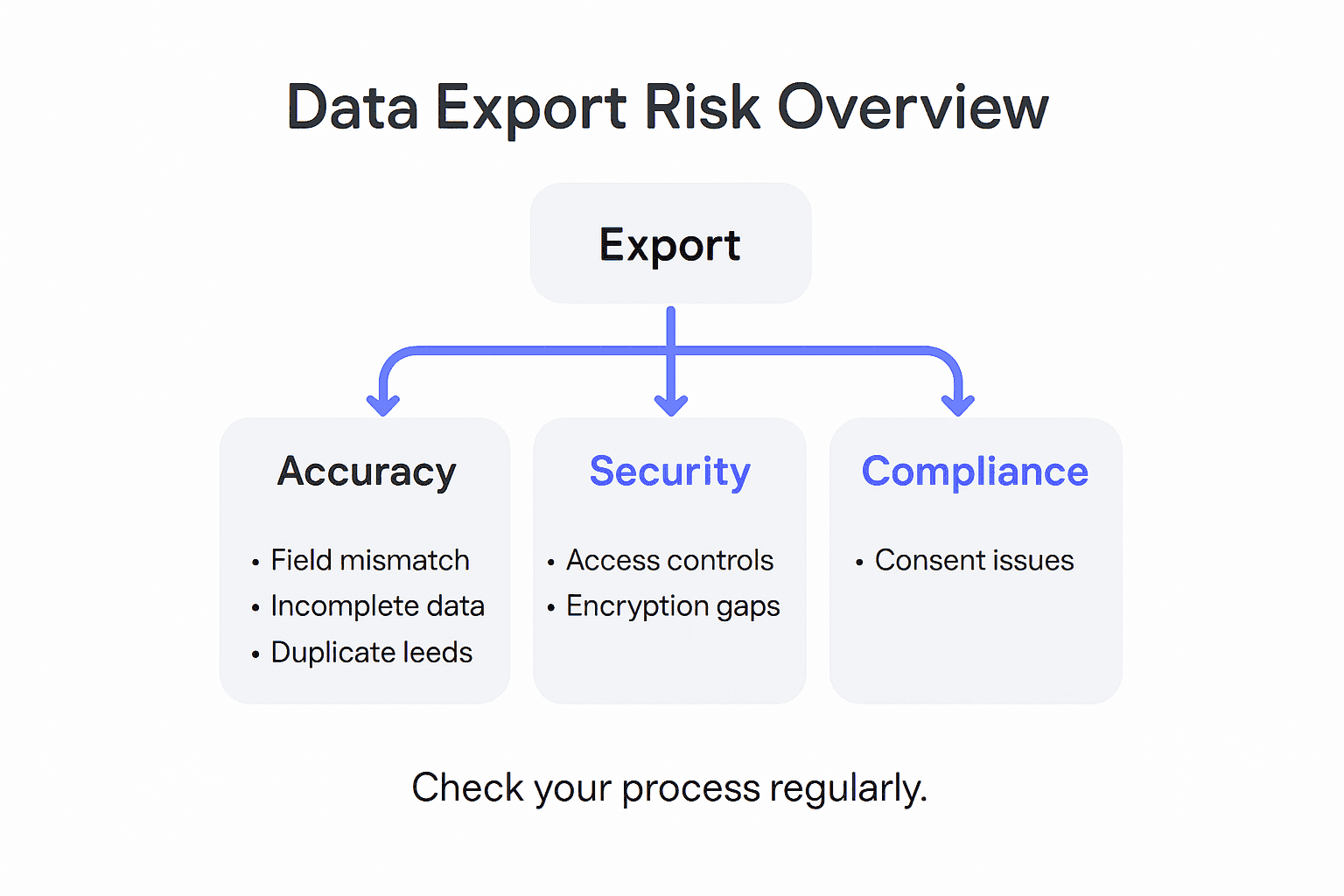
Marketing teams must carefully consider multiple dimensions of risk when executing data export strategies. Compliance requirements vary dramatically across industries and geographic regions, with regulations like GDPR in Europe, CCPA in California, and other international data protection frameworks establishing strict guidelines for personal information handling. These regulations mandate rigorous standards for consent, data storage, individual rights to information access, and the potential right to be forgotten, creating a minefield of potential legal and financial risks for organizations that mishandle professional contact data.
Technical security measures become paramount in mitigating potential data breaches and unauthorized access during export processes. Encryption protocols, multi-factor authentication, secure API connections, and comprehensive access logging represent critical safeguards that protect sensitive professional information. Marketing and sales teams must implement robust data governance frameworks that include regular security audits, comprehensive user access controls, and detailed tracking mechanisms to ensure that every data transfer meets the highest standards of professional confidentiality and regulatory compliance.
Pro Tip: Develop a comprehensive data handling policy that explicitly outlines consent mechanisms, storage protocols, and individual data rights, ensuring your export processes remain transparent and legally defensible.
Common Export Mistakes and How to Avoid Them
Data export mistakes can significantly undermine marketing efficiency, turning potentially valuable insights into costly operational errors. Professionals must develop a keen understanding of the most common pitfalls that can compromise data integrity, lead generation accuracy, and overall campaign performance.
Marketing data export errors frequently stem from inconsistent monitoring and misaligned performance metrics, creating a cascade of ineffective decision making. The most prevalent mistakes include relying on superficial vanity metrics, failing to establish real-time analysis protocols, and neglecting systematic data review processes. These errors can lead to misguided campaign strategies, wasted resources, and missed opportunities for meaningful customer engagement.
Technical challenges compound the risk of data export mistakes. Incomplete data mapping, incorrect field transfers, duplicate record generation, and inadequate data validation mechanisms can introduce significant inaccuracies into marketing databases. Sales and marketing teams must implement robust validation checkpoints, use automated data cleansing tools, and develop comprehensive cross-referencing strategies to ensure that exported information maintains high standards of accuracy and reliability. Implementing multi-stage verification processes, setting up automated alert systems, and conducting regular data quality audits can dramatically reduce the potential for critical export errors.
This summary highlights common export mistakes and prevention strategies for marketing teams:
| Common Mistake | Business Impact | Prevention Strategy |
|---|---|---|
| Mapping fields incorrectly | Campaigns miss key information | Use detailed field mapping docs |
| Skipping data validation | Leads to inaccurate analytics | Implement automated checks |
| Allowing duplicate records | Inflates workloads and costs | Schedule routine deduplication |
| Ignoring compliance updates | Risk of legal and financial issues | Regular compliance training |
Pro Tip: Establish a quarterly data export audit protocol that systematically reviews your export processes, identifying and correcting potential accuracy and integration issues before they can impact campaign performance.
Enhance Your Marketing Workflow by Mastering Data Export Accuracy
The article highlights the critical challenges marketing professionals face with data export such as maintaining data accuracy, preventing duplicate records, and ensuring seamless CRM integration. These pain points can slow lead generation and reduce the effectiveness of outreach efforts. If you are seeking to boost lead accuracy and simplify the often complex and error-prone process of transferring LinkedIn contact information directly into your CRM, it is time to leverage smarter tools designed for your needs.
LeadLx offers a powerful solution that addresses exactly these challenges by seamlessly connecting LinkedIn data extraction to CRM platforms like HubSpot and Salesforce with a user-friendly browser extension. You can instantly capture and export contact and company information without manual entry or switching tabs. This automation helps eliminate data export mistakes, maintains flawless synchronization across your sales and marketing teams, and saves you valuable time typically lost to repetitive tasks.
Take control of your marketing data exports today and avoid the common pitfalls discussed in the article. Explore how LeadLx enhances your workflow by reducing manual errors, ensuring compliant and accurate data handling, and powering your prospecting with real-time LinkedIn insights at LeadLx.

Ready to experience effortless CRM integration and superior lead data accuracy? Visit LeadLx and start transforming your marketing workflow now. For a closer look at harnessing LinkedIn for precise lead management, check out our detailed insights on LinkedIn CRM Integration. Don’t wait to turn data export challenges into strategic advantages.
Frequently Asked Questions
What is data export in marketing workflows?
Data export in marketing workflows refers to the systematic process of extracting information from one platform and transferring it into another. This enables marketing teams to streamline lead management, perform sophisticated segmentation, and optimize campaign targeting.
What are the main stages of the data export process?
The data export process typically involves three main stages: extraction, transformation, and loading (ETL). These stages help convert raw contact details into actionable intelligence for strategic decision-making.
How does automated data export improve marketing workflows?
Automated data export enhances marketing workflows by significantly increasing efficiency and scalability. It reduces human error, accelerates data processing, and ensures consistent, repeatable data transfer across complex marketing systems.
What are common mistakes to avoid in data export?
Common mistakes in data export include incorrect mapping of data fields, skipping data validation, allowing duplicate records, and ignoring compliance updates. Implementing verification processes and automated checks can help prevent these issues.
Recommended
- Time-Saving Prospecting Methods for Efficient Lead Capture
- 7 Essential HubSpot Sales Tips for CRM Success
- Prospecting Process Optimization: Boost Sales Efficiency Fast
- Contact Information Management Tutorial for CRM Success
- 10 Effective Lead Generation Strategies for Businesses – Jarrod Harman
- Master the Lead Generation Process for 2025 Success – Go Online Now