
Bold team collaboration can deliver up to 25 percent higher productivity in American sales organizations using platforms like HubSpot or Salesforce. For sales and marketing professionals across North America, seamless cooperation translates directly into more qualified LinkedIn leads and efficient prospecting. Understanding how modern collaboration breaks down silos helps you design a smarter lead generation system that connects people, ideas, and opportunity at every step.
Key Takeaways
| Point | Details |
|---|---|
| Team Collaboration is Essential | Effective collaboration among sales, marketing, and support teams enhances customer experiences and drives better results. |
| Define Clear Roles | Clearly defined roles within the sales team optimize efficiency and ensure accountability in the sales process. |
| Leverage CRM Effectively | Integrating a CRM system promotes real-time data sharing and improves team coordination across functions. |
| Address Implementation Challenges | Proactively tackling common CRM challenges, such as data quality and user adoption, ensures sustained collaboration success. |
Defining Team Collaboration in Sales
Team collaboration in sales represents a strategic approach where multiple professionals work together seamlessly to achieve shared organizational goals. Unlike traditional siloed sales strategies, modern collaboration emphasizes interconnected efforts that leverage collective expertise and resources. Sales collaboration requires coordinated communication across different departments and roles.
At its core, effective sales team collaboration involves breaking down traditional barriers between individual salespeople, marketing teams, and customer support groups. This integrated approach means sharing critical customer insights, coordinating outreach strategies, and maintaining a unified understanding of potential and existing client needs. High-performing sales teams recognize that collaboration isn’t just about working together but creating a synchronized ecosystem where information flows freely and efficiently.
Successful collaboration demands specific organizational capabilities. Teams must establish clear communication channels, develop shared performance metrics, and create an environment of psychological safety where members can openly share challenges and ideas. Cross-functional teamwork becomes essential for navigating complex sales landscapes, particularly in rapidly changing market conditions where adaptability is crucial.
Pro tip: Schedule weekly cross-departmental meetings to ensure alignment and create dedicated communication channels that facilitate rapid information exchange between sales, marketing, and customer support teams.
Types of Collaboration Across Sales Teams
Sales team collaboration manifests through multiple sophisticated models, each designed to optimize performance and customer engagement. Inside-outside sales team dynamics represent a primary collaboration strategy where specialized roles work in tandem to deliver comprehensive customer experiences. This approach typically involves inside sales representatives managing remote communication and digital interactions, while outside sales professionals handle strategic in-person meetings and complex negotiations.
Another critical collaboration type emerges through cross-functional partnerships between sales, marketing, and customer support teams. These interdepartmental relationships focus on creating seamless customer journeys by sharing critical insights, aligning messaging, and developing integrated strategies. Prospecting process optimization becomes significantly more effective when teams break down traditional operational silos and develop a unified approach to client acquisition and retention.
Technology-enabled collaboration represents the most advanced form of sales team interaction. Modern sales organizations leverage collaborative tools, shared CRM platforms, and real-time communication channels to enable instant knowledge sharing, coordinate complex sales initiatives, and provide comprehensive customer support. These digital collaboration mechanisms allow sales teams to work as integrated networks rather than isolated individual contributors, dramatically improving response times and strategic alignment.
See how different sales collaboration models compare in structure and impact:
| Collaboration Model | Key Departments Involved | Core Strength |
|---|---|---|
| Inside-Outside Sales | Inside and Outside Sales Teams | Balanced customer coverage |
| Cross-Functional | Sales, Marketing, Support | Unified client strategies |
| Tech-Enabled | All (via digital platforms) | Real-time data sharing |
Pro tip: Implement a quarterly cross-departmental workshop to align sales strategies, share best practices, and foster a culture of collaborative learning across your organization.
How CRM Integration Streamlines Collaboration
CRM integration represents a transformative approach to breaking down communication barriers within sales organizations. Centralizing data and communication channels enables teams to create a unified ecosystem where information flows seamlessly across departments. By consolidating customer interactions, contact details, and engagement histories into a single platform, sales teams can develop more strategic and personalized approaches to client relationships.

The core strength of CRM integration lies in its ability to eliminate traditional operational silos. Syncing real-time data between sales and marketing teams allows for unprecedented levels of collaboration and insight sharing. Sales representatives can now access comprehensive customer profiles, track interaction histories, and leverage marketing insights to craft more targeted engagement strategies. This holistic approach transforms disconnected individual efforts into a coordinated, intelligence-driven sales process.
Modern CRM integration goes beyond simple data sharing. Advanced platforms now provide interactive dashboards, real-time performance analytics, and collaborative tools that enable teams to track leads, monitor sales pipelines, and make data-driven decisions instantly. These technological capabilities create a dynamic environment where team members can quickly align strategies, share critical insights, and respond to market changes with unprecedented agility. The result is a more responsive, informed, and ultimately more successful sales organization.
Pro tip: Conduct monthly cross-functional CRM data review sessions to ensure all teams understand shared insights and maintain consistent customer engagement strategies.
Key Roles and Responsibilities for Success
Sales team effectiveness depends on clearly defined roles and seamless interactions between different functional positions. Sales role definitions create critical collaboration frameworks that ensure each team member understands their specific responsibilities and contribution to the overall sales process. Typically, these roles include Sales Development Representatives (SDRs), Business Development Representatives (BDRs), Account Executives (AEs), and Account Managers (AMs), each playing a unique part in the customer acquisition and retention journey.
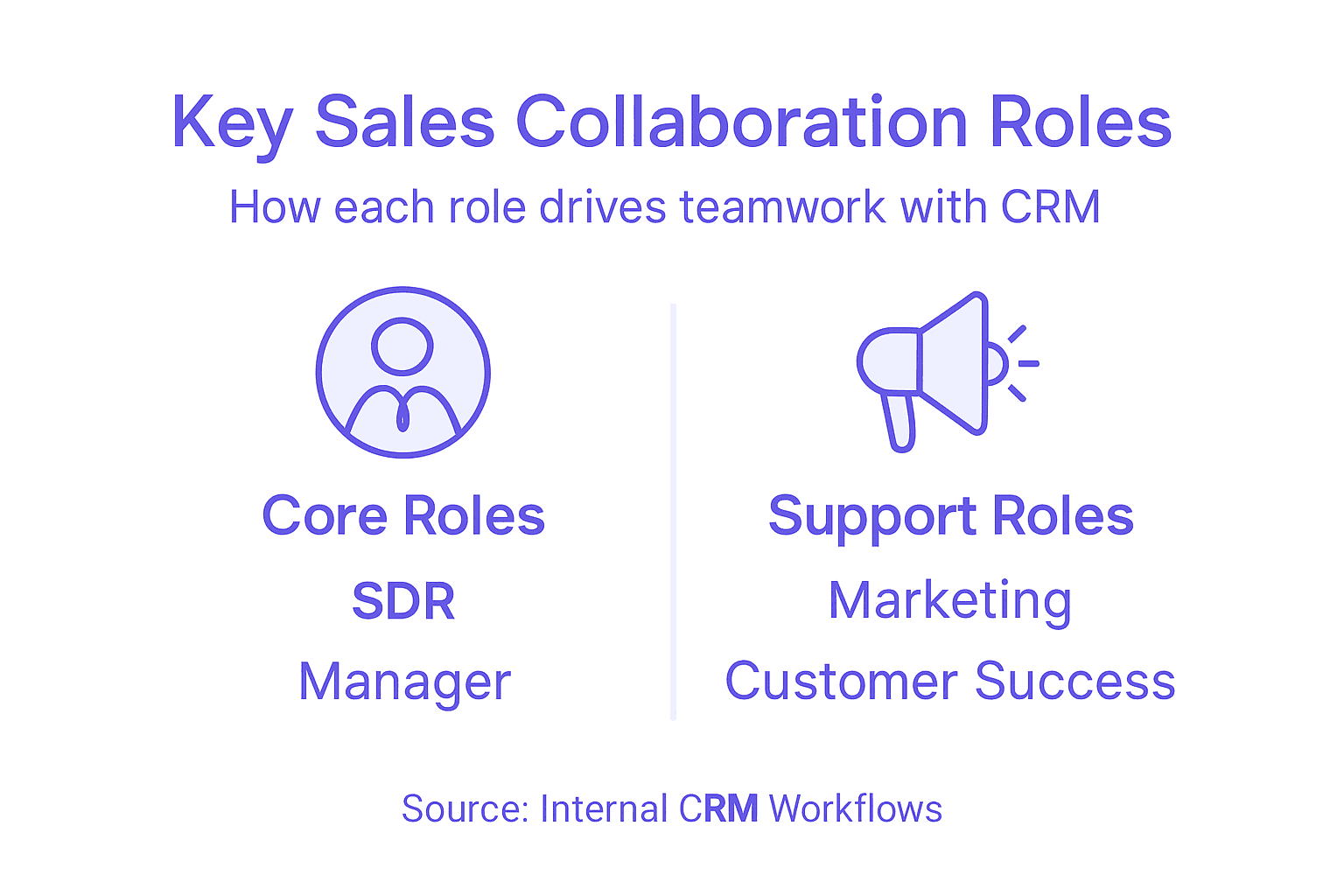
Sales Development Representatives focus on generating and qualifying initial leads, acting as the first point of contact in the sales pipeline. Business Development Representatives concentrate on strategic partnerships and outbound sales strategies, identifying potential business opportunities and creating initial engagement pathways. Account Executives take these qualified leads and manage the critical process of closing deals, using their negotiation skills and deep product knowledge to transform potential opportunities into confirmed sales. Account Managers then step in to nurture ongoing customer relationships, ensuring client satisfaction, managing account health, and identifying opportunities for upselling and long-term growth.
Here’s a summary of major sales team roles and their primary collaboration responsibilities:
| Role | Main Responsibility | Contribution to Collaboration |
|---|---|---|
| Sales Development Representative | Generate and qualify leads | Provides foundation for pipeline |
| Business Development Representative | Build strategic partnerships | Expands market reach |
| Account Executive | Close deals and negotiate terms | Drives revenue conversion |
| Account Manager | Nurture ongoing client accounts | Ensures long-term client retention |
Successful sales organizations recognize that these roles are interconnected and require robust communication channels and shared performance metrics. Each role contributes to a comprehensive sales strategy, with clear handoff processes that minimize friction and maximize efficiency. By establishing transparent expectations, providing continuous training, and creating collaborative platforms that enable seamless information sharing, teams can develop a high-performance sales ecosystem that adapts quickly to changing market dynamics and customer needs.
Pro tip: Develop a detailed role transition matrix that clearly outlines responsibilities, communication protocols, and performance expectations for each sales team position.
Common Pitfalls and How to Avoid Them
CRM integration challenges can derail even the most well-intentioned sales collaboration efforts. Identifying and addressing common implementation mistakes is crucial for maintaining team productivity and achieving strategic objectives. The most significant obstacles often stem from data management, user adoption, and systemic implementation approaches that fail to consider the nuanced needs of sales teams.
One primary pitfall involves poor data quality and inconsistent input practices. Sales teams frequently struggle with incomplete, duplicate, or inaccurate customer information that undermines the entire CRM’s effectiveness. CRM implementation requires strategic planning that emphasizes data governance, standardized entry protocols, and regular system audits. Organizations must establish clear guidelines for data capture, implement validation mechanisms, and create accountability for maintaining accurate customer records. This approach ensures that the CRM becomes a reliable source of truth rather than a repository of fragmented, unreliable information.
Another critical challenge is user adoption and resistance to technological change. Many sales professionals view CRM systems as administrative burdens rather than strategic tools. Overcoming this requires a comprehensive change management strategy that involves thorough training, demonstrating tangible benefits, and designing intuitive interfaces that integrate seamlessly into existing workflow processes. By focusing on user experience and providing personalized training that shows how the CRM directly improves individual performance, organizations can transform potential resistance into enthusiastic engagement.
Pro tip: Conduct monthly CRM usage reviews and provide personalized feedback to team members, highlighting individual performance improvements directly tied to effective system utilization.
Transform Your Sales Team Collaboration With Smart CRM Integration
The challenges highlighted in the article around maintaining seamless communication, avoiding data silos, and enhancing cross-functional collaboration are exactly what sales teams face every day. Pain points like fragmented customer data, inefficient prospecting workflows, and the risk of duplicate entries undermine your team’s ability to act fast and close deals. Leveraging modern CRM integration combined with LinkedIn prospecting tools can turn these hurdles into competitive advantages.
LeadLx offers a powerful solution designed to address these very issues by integrating HubSpot and Salesforce directly with LinkedIn. Our browser extension overlays CRM insights on LinkedIn profiles, enabling instant extraction and one-click updates to your CRM without switching tabs. This streamlines data management, reduces repetitive manual entry, and improves team visibility and collaboration. By adopting LeadLx, your sales team can save up to 10 hours per week and focus on what matters most — nurturing relationships and closing sales.
Discover how LeadLx’s unique features can enhance your prospecting and strengthen your sales collaboration ecosystem. Explore more about our platform at LeadLx. Explore how CRM integration solves common data challenges here. Ready to revolutionize your team’s workflow and boost results? Visit LeadLx to get started today.
Take control of your sales collaboration now by visiting LeadLx. See how effortless CRM integration with LinkedIn can empower your team to act faster, collaborate better, and close more deals.
Frequently Asked Questions
What is team collaboration in sales?
Team collaboration in sales refers to a strategic approach where multiple professionals work together to achieve shared goals, breaking down silos between different roles, such as sales, marketing, and customer support.
How does CRM integration enhance sales team collaboration?
CRM integration centralizes data and communication channels, allowing team members to access comprehensive customer profiles and track interactions, leading to improved collaboration and more personalized customer engagement strategies.
What types of collaboration models are commonly used in sales teams?
Common collaboration models include inside-outside sales dynamics, cross-functional teamwork between sales and marketing teams, and tech-enabled collaboration through shared platforms and tools.
What are some common pitfalls to avoid when implementing CRM systems?
Common pitfalls include poor data quality, inconsistent input practices, and user resistance to change. Organizations should focus on data governance, thorough training, and user-friendly interfaces to mitigate these issues.