
Over half of American sales teams report losing valuable hours to manual data entry every week. For professionals focused on LinkedIn outreach and rapid CRM integration, data management inefficiencies often slow progress and impact conversion rates. Discover how advanced company info extraction tools unlock actionable intelligence by transforming raw data from emails, websites, and contracts into organized profiles that fuel smarter sales strategies and targeted engagements.
Key Takeaways
| Point | Details |
|---|---|
| Automated Company Info Extraction | Enables sales teams to rapidly gather and update company data, enhancing sales intelligence without manual input. |
| Integration with CRM | Automates the enrichment of client profiles with real-time data, improving engagement strategies and decision-making. |
| Methodologies and Risks | Different extraction methodologies exist, but algorithmic bias and data accuracy risks must be managed to ensure high-quality outputs. |
| Legal and Compliance Considerations | Organizations must ensure compliance with data privacy regulations and maintain ethical standards when extracting information. |
Defining company info extraction in sales
Company information extraction represents a sophisticated technological approach for transforming unstructured business data into actionable sales intelligence. At its core, this process involves using advanced computational techniques to automatically capture and organize critical business details from various text-based sources. Sales teams leverage these methods to rapidly compile comprehensive company profiles without manual data entry.
The technical foundation of company info extraction relies on natural language processing techniques that systematically analyze text documents to identify key organizational attributes. These advanced algorithms can recognize and extract structured data such as company names, financial metrics, leadership details, contact information, and potential business relationships from sources like emails, websites, contracts, and industry reports. By converting raw text into machine-readable formats, sales professionals can quickly build rich, dynamic databases that support strategic decision-making.
Modern company info extraction goes beyond simple data collection. Advanced deep learning models can now contextualize information, understanding nuanced relationships and hierarchical structures within organizational data. These intelligent systems can differentiate between similar company names, track organizational changes, and even predict potential business opportunities based on extracted insights. Sales teams utilizing these technologies can develop more targeted prospecting strategies, improve lead qualification processes, and create more personalized engagement approaches.
Pro tip: Implement automated company info extraction tools that integrate directly with your CRM to reduce manual data entry and improve overall sales intelligence accuracy.
Key variations and extraction tools
Company information extraction technologies have evolved into diverse methodologies, each offering unique approaches to transforming unstructured business data. Multimodal extraction techniques represent the cutting edge of this technological landscape, combining multiple data processing strategies to enhance accuracy and comprehensiveness.
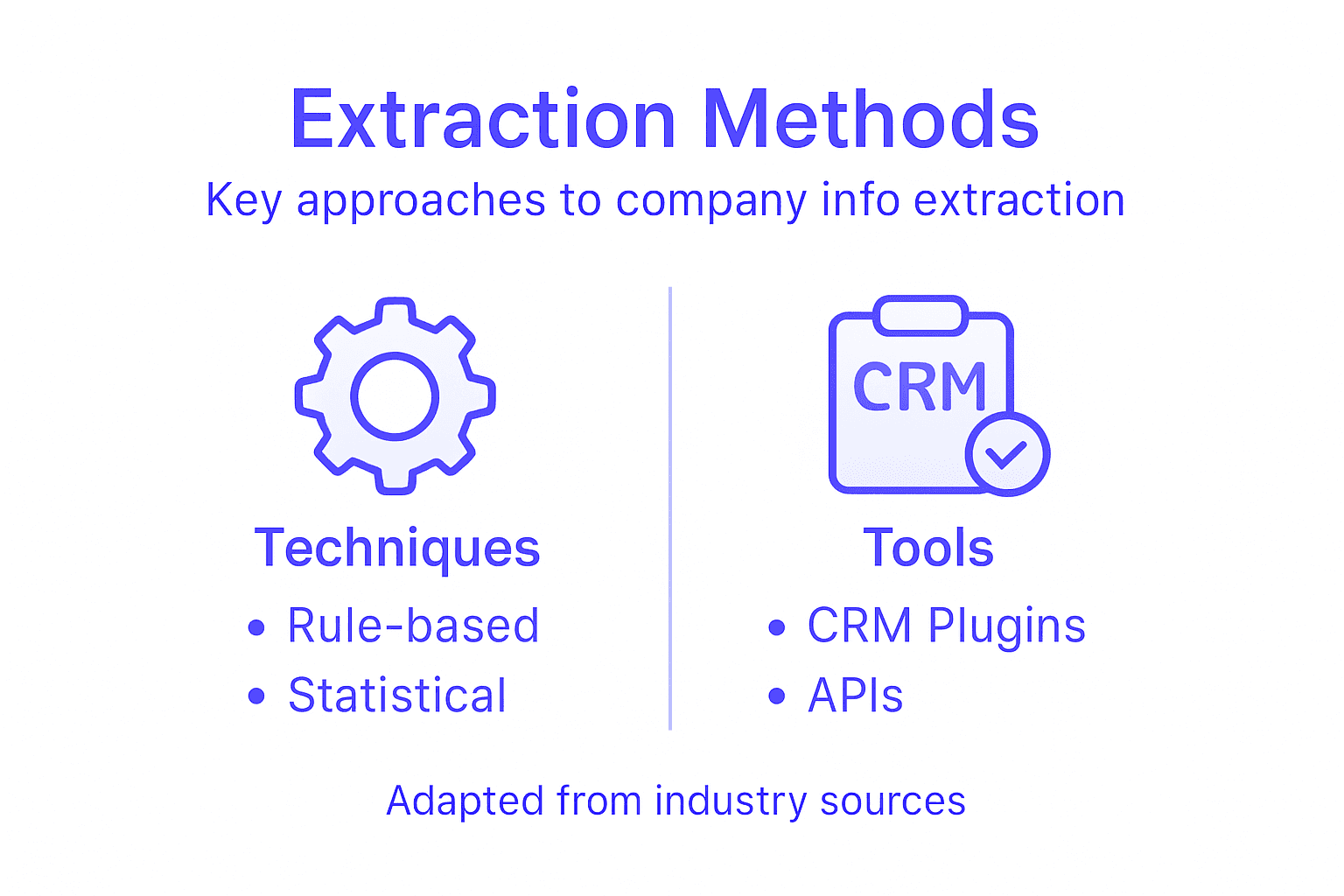
Three primary extraction methodologies dominate the current technological ecosystem: rule-based, statistical, and deep learning approaches. Rule-based methods rely on predefined patterns and explicit instructions for data identification, making them highly structured but less flexible. Statistical models introduce probabilistic reasoning, learning from training datasets to recognize complex information patterns. Deep learning approaches, by contrast, utilize advanced neural networks that can autonomously discover intricate relationships within business documents, adapting and improving their extraction capabilities through continuous learning.
Modern extraction tools increasingly employ hybrid strategies that blend these approaches. Advanced systems now incorporate optical character recognition (OCR), natural language processing, and layout analysis to handle diverse document types like invoices, contracts, websites, and email communications. These sophisticated tools can differentiate between similar company names, track organizational changes, and extract nuanced contextual information that traditional methods might miss. The result is a more intelligent, adaptive approach to company data extraction that provides sales teams with rich, actionable intelligence.
Here’s a comparison of common company information extraction methodologies and their business impacts:
| Methodology | Key Approach | Strengths | Limitations |
|---|---|---|---|
| Rule-based | Predefined patterns, explicit rules | High precision for structured data | Limited flexibility, poor adaptation |
| Statistical | Probabilistic modeling | Learns complex patterns | Requires extensive training data |
| Deep learning | Neural networks, continuous learning | Contextual understanding, adaptation | Resource-intensive, less transparent |
This summary outlines typical use cases for sales teams leveraging company information extraction:
| Use Case | Advantage | Common Sources |
|---|---|---|
| Strategic Prospecting | Identifies target decision-makers | Websites, industry reports |
| Account Management | Tracks company changes | News platforms, financial filings |
| Opportunity Tracking | Detects expansion signals | Professional networking sites |
Pro tip: Select extraction tools that offer seamless CRM integration and support multiple document formats to maximize your data collection efficiency.
How automated extraction integrates with CRMs
Automated company information extraction represents a revolutionary approach to streamlining CRM data management, transforming how sales teams collect and utilize business intelligence. Continuous data enrichment strategies enable sales professionals to automatically update client profiles with real-time insights, eliminating the need for manual research and data entry.
The integration process typically involves sophisticated API connections and intelligent data mapping between extraction tools and CRM platforms. Automated extraction systems can pull comprehensive company information from multiple sources, including web repositories, financial filings, news platforms, and professional networking sites. This approach allows for dynamic profile updates that capture critical details such as company size, revenue, recent organizational changes, leadership transitions, and technological infrastructure. Sales teams gain access to constantly refreshed intelligence that supports more targeted and personalized engagement strategies.
Modern CRM integration goes beyond simple data collection. Advanced extraction technologies now leverage machine learning algorithms to not just transfer data, but to contextualize and prioritize information. These intelligent systems can identify potential sales opportunities, flag significant company changes, and even suggest optimal communication strategies based on the extracted insights. By reducing manual data entry and providing rich, actionable intelligence, automated extraction transforms CRM platforms from static databases into dynamic, predictive business intelligence tools that empower sales professionals to make more informed decisions.
Pro tip: Choose extraction tools that offer direct, two-way synchronization with your CRM to ensure real-time data accuracy and minimal manual intervention.
Typical use cases for sales teams
Company information extraction technologies have emerged as powerful tools that transform how sales teams approach prospecting, lead generation, and client relationship management. Research insights for sales strategies provide critical intelligence that enables more targeted and effective engagement approaches across multiple business scenarios.

Strategic prospecting represents one of the most significant use cases for automated company information extraction. Sales professionals can leverage these technologies to develop comprehensive profiles of potential clients, identifying key decision-makers, understanding organizational structures, and uncovering potential pain points before initial contact. The extracted data helps teams prioritize leads, personalize outreach strategies, and develop more nuanced communication approaches that demonstrate deep understanding of a prospect’s business context and potential challenges.
Beyond initial prospecting, automated extraction tools play a crucial role in account management and opportunity tracking. Sales teams can continuously monitor company developments, track leadership changes, analyze financial performance, and identify expansion or transformation signals that might indicate potential sales opportunities. These intelligent systems provide real-time updates that enable proactive engagement, allowing sales professionals to time their interventions precisely and approach potential clients with highly relevant, contextually informed proposals. By transforming raw data into actionable intelligence, company information extraction empowers sales teams to move from reactive selling to strategic, insight-driven relationship building.
Pro tip: Implement a systematic approach to reviewing and acting on extracted company intelligence at least weekly to maintain competitive advantage and responsiveness.
Legal and compliance issues in extraction
Company information extraction technologies operate within a complex legal landscape that demands rigorous attention to data privacy and ethical standards. Data privacy regulations have created a challenging environment where sales teams must balance technological capabilities with strict legal requirements, ensuring that every piece of extracted information complies with national and international data protection frameworks.
Consent and transparency emerge as critical legal considerations in automated data extraction processes. Organizations must implement robust mechanisms to verify the legal basis for collecting and processing company information, particularly when dealing with personal data associated with business contacts. This involves obtaining explicit consent, providing clear information about data usage, and maintaining comprehensive audit trails that demonstrate compliance with regulations like GDPR, CCPA, and other regional data protection laws. Failure to adhere to these requirements can result in significant financial penalties and reputational damage.
Beyond data privacy, legal compliance extends to respecting intellectual property rights and confidentiality constraints. Sales teams must carefully navigate the fine line between publicly available information and proprietary data, ensuring that extraction technologies do not inadvertently capture or misuse confidential business intelligence. This requires sophisticated filtering mechanisms, clear ethical guidelines, and continuous monitoring of extraction processes to prevent potential legal breaches. Organizations must develop comprehensive compliance strategies that balance the need for business intelligence with robust legal safeguards, creating a framework that protects both the data subject and the collecting organization.
Pro tip: Consult with legal counsel to develop a comprehensive data extraction compliance framework that addresses specific regulatory requirements in your operational jurisdictions.
Common risks and mistakes to avoid
Company information extraction technologies present several critical challenges that can significantly undermine their effectiveness if not carefully managed. Data accuracy risks emerge as a primary concern, with potential errors stemming from complex source documents, algorithmic limitations, and inconsistent data formatting that can compromise the entire extraction process.
Algorithmic bias represents a significant risk in automated extraction systems. Many organizations fall into the trap of over-relying on rigid, rule-based models that fail to adapt to nuanced or evolving document structures. These systems often struggle with recognizing industry-specific terminologies, handling complex organizational hierarchies, or accommodating variations in company documentation. Sales teams may unknowingly propagate inaccurate information by trusting extraction tools that lack sophisticated contextual understanding and adaptive learning capabilities.
Technical vulnerabilities extend beyond simple data inaccuracies. Extraction tools can inadvertently introduce systemic errors through improper training data selection, insufficient domain adaptation, and lack of comprehensive validation mechanisms. Complex business documents often contain intricate relationships and contextual subtleties that require advanced machine learning models capable of understanding cross-document dependencies and interpreting nuanced organizational information. Successful extraction strategies must incorporate human oversight, continuous model refinement, and multi-layered validation processes to mitigate potential risks and maintain high-quality data integrity.
Pro tip: Implement a quarterly audit process that randomly samples extracted data to verify accuracy and identify potential systemic extraction errors.
Boost Your Sales Efficiency with Automated Company Info Extraction
The article highlights how critical accurate and real-time company information extraction is for sales teams aiming to reduce manual data entry and make smarter prospecting decisions. If you struggle with time-consuming CRM updates or fragmented data from LinkedIn profiles, you are not alone. The challenge is extracting rich company and contact information seamlessly while maintaining data accuracy and avoiding duplicate entries. LeadLx directly addresses these pain points by integrating powerful automation into your existing sales workflow.
With LeadLx, you get a browser extension that overlays CRM data like HubSpot or Salesforce directly on LinkedIn profiles. This lets you instantly extract company info and contact details without switching tabs or copying and pasting. The platform features bulk data extraction, automatic CRM updates, and shared visibility to prevent duplicate records. This delivers the kind of continuous data enrichment and CRM integration the article emphasizes as essential for modern sales success.
Ready to save approximately 10 hours per week and boost your prospecting accuracy? See how effortless company info extraction can be with LeadLx.
Experience firsthand how LeadLx streamlines your sales intelligence process. Visit LeadLx to start your free trial today and transform your CRM efficiency with automated company info extraction integrated smoothly with LinkedIn and your sales tools.
Frequently Asked Questions
What is company information extraction?
Company information extraction is a technology-driven process that transforms unstructured business data into structured, actionable sales intelligence. It uses advanced algorithms to automatically capture and organize key business details from various sources.
How can sales teams benefit from automated company info extraction?
Sales teams can use automated company info extraction to rapidly compile comprehensive company profiles, improving prospect targeting, lead qualification, and engagement strategies, while reducing manual data entry.
What are the main methodologies used in company information extraction?
The primary methodologies include rule-based approaches, which rely on predefined patterns; statistical models that learn from data; and deep learning techniques that utilize neural networks to discover complex relationships in data.
What legal considerations should sales teams keep in mind when using company info extraction tools?
Sales teams must ensure compliance with data privacy regulations, obtain consent for data collection, and respect intellectual property rights. Implementing robust filtering mechanisms and ethical guidelines is crucial to navigate these legal challenges.