
More than 80 percent of American SaaS sales teams say integrating CRM with LinkedIn transforms the way they find and nurture leads. For professionals using platforms like HubSpot or Salesforce, harnessing this connection means more targeted outreach and measurable results. Understanding exactly how CRM powers smarter prospecting will reveal practical tools and insights you can use to make every lead count.
Key Takeaways
| Point | Details |
|---|---|
| CRM is Essential for Lead Generation | CRM systems provide a structured approach to analyze and optimize customer interactions, significantly enhancing lead generation efforts. |
| Different CRM Types Offer Unique Benefits | Operational, analytical, and collaborative CRMs serve distinct functions that can improve lead management and customer engagement strategies. |
| Integration with LinkedIn Enhances Prospecting | Leveraging Social CRM to connect with LinkedIn allows for better tracking of potential leads and streamlines data management. |
| Common Workflow Mistakes Can Hinder Success | Misaligned handoffs and inconsistent data entry can create significant challenges in lead conversion and overall sales effectiveness. |
Defining CRM and Its Role in Lead Generation
Customer Relationship Management (CRM) represents a strategic approach businesses use to organize, track, and optimize interactions with potential and existing customers. At its core, CRM goes beyond simple contact management – it’s a comprehensive system designed to systematically analyze customer relationships through integrated technology and data-driven insights.
Modern CRM systems serve as powerful lead generation platforms, enabling sales and marketing teams to capture, nurture, and convert prospects more effectively. These sophisticated platforms collect detailed information about potential customers, track their interactions across multiple channels, and provide actionable intelligence that helps businesses personalize their outreach. By aggregating data from email, social media, website interactions, and direct communications, CRM tools create a holistic view of each lead’s journey and potential.
The primary functions of CRM in lead generation include comprehensive lead tracking, precise segmentation, and targeted communication strategies. Sales professionals can now categorize leads based on specific behaviors, engagement levels, and potential value, allowing for more strategic and efficient conversion approaches. Advanced CRM systems employ machine learning algorithms that can predict lead likelihood, recommend optimal communication times, and suggest personalized engagement tactics.
Pro tip: Configure your CRM’s lead scoring system to automatically prioritize and route high-potential prospects to the most appropriate sales representative, reducing response times and improving conversion rates.
Types of CRM Systems for Lead Management
Businesses have several strategic approaches to managing customer relationships through different types of CRM systems, each designed to address specific organizational needs. These systems can be broadly categorized into three primary classifications: operational, analytical, and collaborative CRM, each with unique capabilities and strategic advantages for lead management and customer engagement.
Operational CRM focuses on streamlining day-to-day customer interaction processes across sales, marketing, and customer service departments. This system automates critical tasks like lead capture, contact management, and communication tracking. By integrating multiple touchpoints, operational CRM helps businesses create seamless customer experiences and reduce manual data entry, allowing sales teams to concentrate on high-value relationship-building activities.
Analytical and collaborative CRM systems provide deeper insights and enhanced communication strategies. Analytical CRM leverages advanced data mining and machine learning techniques to extract meaningful patterns from customer interactions, enabling predictive lead scoring and more targeted marketing campaigns. Meanwhile, Collaborative CRM emphasizes communication across different departments and external stakeholders, ensuring that customer information and interaction history are shared transparently and efficiently across the organization.

Pro tip: Evaluate your organization’s specific lead management requirements and choose a CRM system that offers the most suitable combination of operational, analytical, and collaborative features to maximize your sales potential.
Here’s a comparison of the three main types of CRM systems and their lead management benefits:
| CRM Type | Core Focus | Lead Management Benefit |
|---|---|---|
| Operational CRM | Automates daily interactions | Faster lead capture and response |
| Analytical CRM | Data analysis and forecasting | Enhanced lead scoring and targeting |
| Collaborative CRM | Cross-department communication | Consistent lead nurturing and sharing |
How CRM Integrates With LinkedIn Prospecting
Social CRM has revolutionized lead generation by transforming how businesses connect with potential clients through professional networks like LinkedIn. Social CRM integration enables sales professionals to seamlessly capture and track prospect interactions across digital platforms, creating a comprehensive view of potential customer relationships.
The integration process typically involves connecting LinkedIn data directly into CRM systems, allowing automatic synchronization of professional contact information, recent activity, and engagement metrics. Sales teams can now capture LinkedIn profile details, track connection histories, and automatically populate CRM records with rich professional context. This approach eliminates manual data entry, reduces potential errors, and provides a more holistic understanding of prospect backgrounds, interests, and potential business opportunities.
Advanced LinkedIn CRM integrations leverage sophisticated data mapping techniques to extract and categorize information systematically. Intelligent matching algorithms can now cross-reference LinkedIn profile data with existing CRM contacts, identifying potential leads, preventing duplicate entries, and creating more nuanced lead scoring models. By analyzing professional network connections, recent job changes, shared connections, and engagement patterns, businesses can develop more targeted and personalized outreach strategies that significantly improve conversion potential.
Pro tip: Configure your CRM’s LinkedIn integration to automatically flag high-potential connections based on mutual professional networks, recent job changes, and engagement levels to prioritize your prospecting efforts.
Key Features Enhancing Lead Generation Efficiency
Modern CRM systems have evolved to become powerful platforms that dramatically improve lead generation through advanced data analytics capabilities. These sophisticated tools go beyond simple contact management, offering comprehensive features that transform how businesses identify, nurture, and convert potential customers. By integrating multiple data sources and employing intelligent technologies, CRM systems provide sales teams with unprecedented insights and automation capabilities.
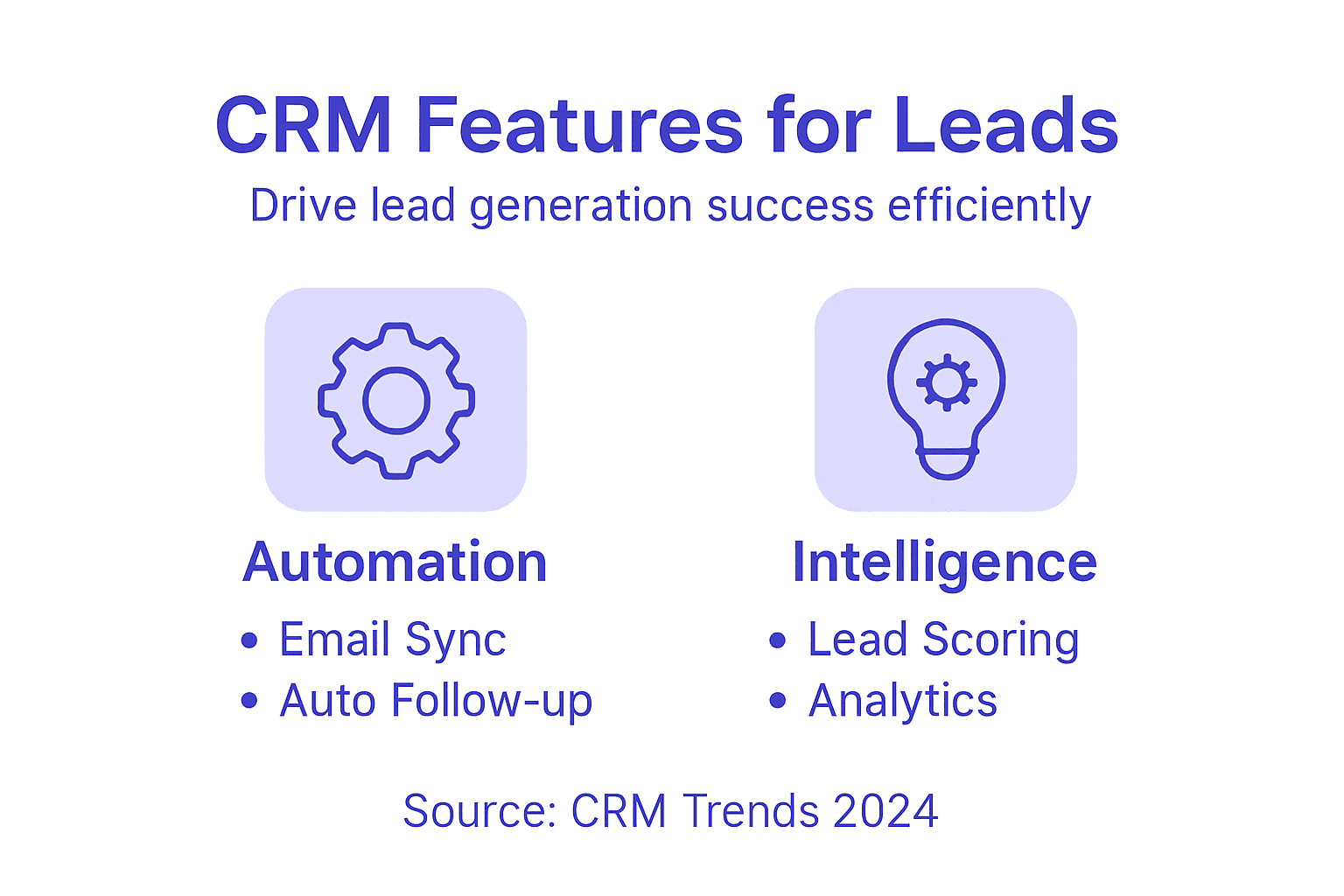
Predictive Lead Scoring represents a game-changing feature that enables businesses to prioritize their most promising prospects. Advanced machine learning algorithms analyze historical data, engagement patterns, and behavioral signals to assign numerical scores to potential leads. This approach allows sales teams to focus their energy on high-potential contacts, dramatically reducing time wasted on low-probability opportunities and increasing overall conversion efficiency.
Comprehensive CRM features now include robust automation tools that streamline the entire lead generation workflow. Automated email campaigns, integrated communication channels, and customizable sales pipelines work together to create a seamless lead nurturing process. These systems can automatically track interactions, send personalized follow-ups, and provide real-time analytics that help sales professionals make data-driven decisions. By reducing manual tasks and providing actionable insights, modern CRM tools enable more strategic and targeted lead generation approaches.
Pro tip: Configure your CRM’s lead scoring system to continuously learn and adapt by regularly reviewing and updating the scoring criteria based on actual conversion outcomes and changing market dynamics.
Common Mistakes in CRM-Driven Workflows
Most organizations unknowingly sabotage their lead generation efforts through critical workflow integration errors. These systemic mistakes create bottlenecks that dramatically reduce sales efficiency, preventing teams from converting high-potential leads and maintaining consistent communication strategies. Understanding these common pitfalls is the first step toward building a more streamlined and effective CRM-driven approach.
Misaligned Lead Handoff represents one of the most significant workflow challenges. When marketing and sales teams operate in silos, leads can become stuck in transition, losing momentum and potential value. This disconnect often occurs when there are no clear, standardized protocols for transferring lead information, resulting in communication gaps, duplicate efforts, and missed opportunities. Successful organizations establish precise lead qualification criteria and create transparent, automated handoff mechanisms that ensure smooth transitions between departments.
Inconsistent CRM usage and poor data management further undermine lead generation strategies. Sales teams frequently fail to log interactions, update contact information, or follow established CRM protocols, creating incomplete and unreliable databases. This fragmented approach prevents accurate lead tracking, makes performance analysis difficult, and reduces the overall effectiveness of predictive analytics and targeted marketing campaigns. Implementing mandatory data entry standards, providing comprehensive CRM training, and creating accountability measures can help mitigate these systemic workflow challenges.
Pro tip: Conduct monthly CRM usage audits to identify data entry inconsistencies and provide targeted training to ensure your team maintains high-quality, comprehensive lead information.
Below is a summary of common CRM workflow mistakes and their business impacts:
| Workflow Mistake | Description | Negative Impact on Lead Generation |
|---|---|---|
| Misaligned Lead Handoff | Poor transition between teams | Lost leads and reduced conversions |
| Inconsistent Data Entry | Failure to log interactions properly | Inaccurate reporting and missed sales |
| Lack of CRM Training | Insufficient user guidance | Low adoption and poor data quality |
Supercharge Your Lead Generation with Seamless LinkedIn CRM Integration
The article highlights critical challenges like misaligned lead handoff, inconsistent data entry, and inefficient lead tracking that can stall your sales workflow and reduce conversion rates. If you struggle with switching between LinkedIn and your CRM or spend too much time manually updating records, you understand how these hurdles drain your productivity and accuracy. Integrating powerful solutions that automate contact capture and ensure consistent data synchronization is essential for smarter lead generation.
LeadLx is designed to solve these exact pain points by overlaying HubSpot and Salesforce data directly onto LinkedIn profiles. This not only eliminates the need to switch tabs but also allows instant extraction of prospect and company details with one click. By automating repetitive tasks and providing shared CRM visibility, LeadLx reduces manual errors and empowers sales teams to focus on personalized outreach and faster conversions. Discover how you can boost your sales efficiency and prevent duplicate entries with our innovative platform.
Stop losing leads between systems and start prioritizing your highest-value prospects today. Explore the benefits of integrating LinkedIn with your CRM and streamline your lead management by visiting LeadLx. Learn more about how our solution complements CRM-driven workflows in the article on the Role of CRM in Lead Generation Success and see how LeadLx can transform your prospecting efforts instantly.
Frequently Asked Questions
What is the role of CRM in lead generation?
Customer Relationship Management (CRM) systems help businesses organize, track, and optimize interactions with potential customers. They collect and analyze data, enabling more effective lead nurturing, segmentation, and conversion strategies.
How can CRM systems improve lead tracking?
CRM systems offer comprehensive lead tracking features by capturing interactions across multiple channels. This allows sales teams to monitor engagement levels and categorize potential leads based on their behaviors and interests, leading to more strategic outreach.
What types of CRM systems are best for lead management?
There are three main types of CRM systems: operational, analytical, and collaborative. Operational CRM automates daily interactions, analytical CRM focuses on data analysis for predictive scoring, and collaborative CRM enhances communication across departments.
What common mistakes should be avoided in CRM-driven workflows?
Common mistakes include misaligned lead handoffs, inconsistent data entry, and lack of comprehensive CRM training. These pitfalls can lead to bottlenecks in sales processes and reduced lead conversion rates.