
Most sales teams underestimate how much time slips away on manual prospecting tasks while competitors race ahead. For american and international B2B professionals, every minute spent searching for leads instead of engaging them means missed revenue. Understanding the essentials of B2B prospecting and how powerful integrations like LinkedIn with CRM solutions such as HubSpot or Salesforce can maximize efficiency separates high performers from the rest. Discover actionable strategies to help you turn potential contacts into real business growth.
Key Takeaways
| Point | Details |
|---|---|
| Effective B2B Prospecting | Systematic identification and engagement of potential business clients is crucial for transforming leads into revenue opportunities. |
| Diverse Prospecting Methods | Utilizing a mix of cold outreach, warm calling, referral networking, and digital strategies enhances overall prospecting success. |
| Leverage Technology | Advanced tools and data-driven insights significantly improve targeting, engagement, and overall efficiency in prospecting efforts. |
| Avoid Common Mistakes | Focus on personalized outreach and alignment between sales and marketing to enhance engagement and conversion rates. |
Defining B2B Prospecting and Its Role
B2B prospecting represents the systematic process of identifying, researching, and engaging potential business customers who could benefit from a company’s products or services. At its core, it involves discovering and qualifying potential leads within the business-to-business commercial ecosystem, transforming unknown contacts into potential revenue opportunities.
In practical terms, B2B prospecting goes beyond simple lead generation. It requires strategic research, targeted outreach, and a nuanced understanding of how businesses solve their operational challenges. Sales professionals must meticulously analyze potential client organizations, understanding their specific needs, pain points, and potential alignment with their product or service offering. This means diving deep into company structures, examining organizational goals, and identifying decision makers who can drive purchasing conversations.
Successful B2B prospecting involves multiple interconnected strategies, including leveraging professional networks, conducting targeted research, utilizing advanced sales intelligence tools, and developing personalized communication approaches. Prospecting techniques range from cold outreach and social selling to referral networking and strategic content marketing. The ultimate goal remains consistent: transforming potential business connections into meaningful revenue-generating relationships that provide tangible value to both parties.
Pro Tip for Effective Prospecting: Develop a systematic approach by creating detailed ideal customer profiles that outline specific demographic, firmographic, and behavioral characteristics, enabling more precise and targeted prospecting efforts.
Types of B2B Prospecting Methods
B2B prospecting encompasses a diverse range of strategic approaches designed to identify and engage potential business clients. Effective prospecting strategies include multiple channels and techniques that sales professionals can leverage to expand their potential client base and generate meaningful business opportunities.
The primary methods of B2B prospecting include cold outreach, warm calling, referral networking, and digital engagement strategies. Cold outreach involves direct communication with potential clients who have not previously expressed interest, typically through email, phone calls, or targeted messaging. Warm calling, in contrast, focuses on reaching out to prospects with whom there is already some level of prior connection or mutual understanding, making the interaction more receptive and potentially more successful.
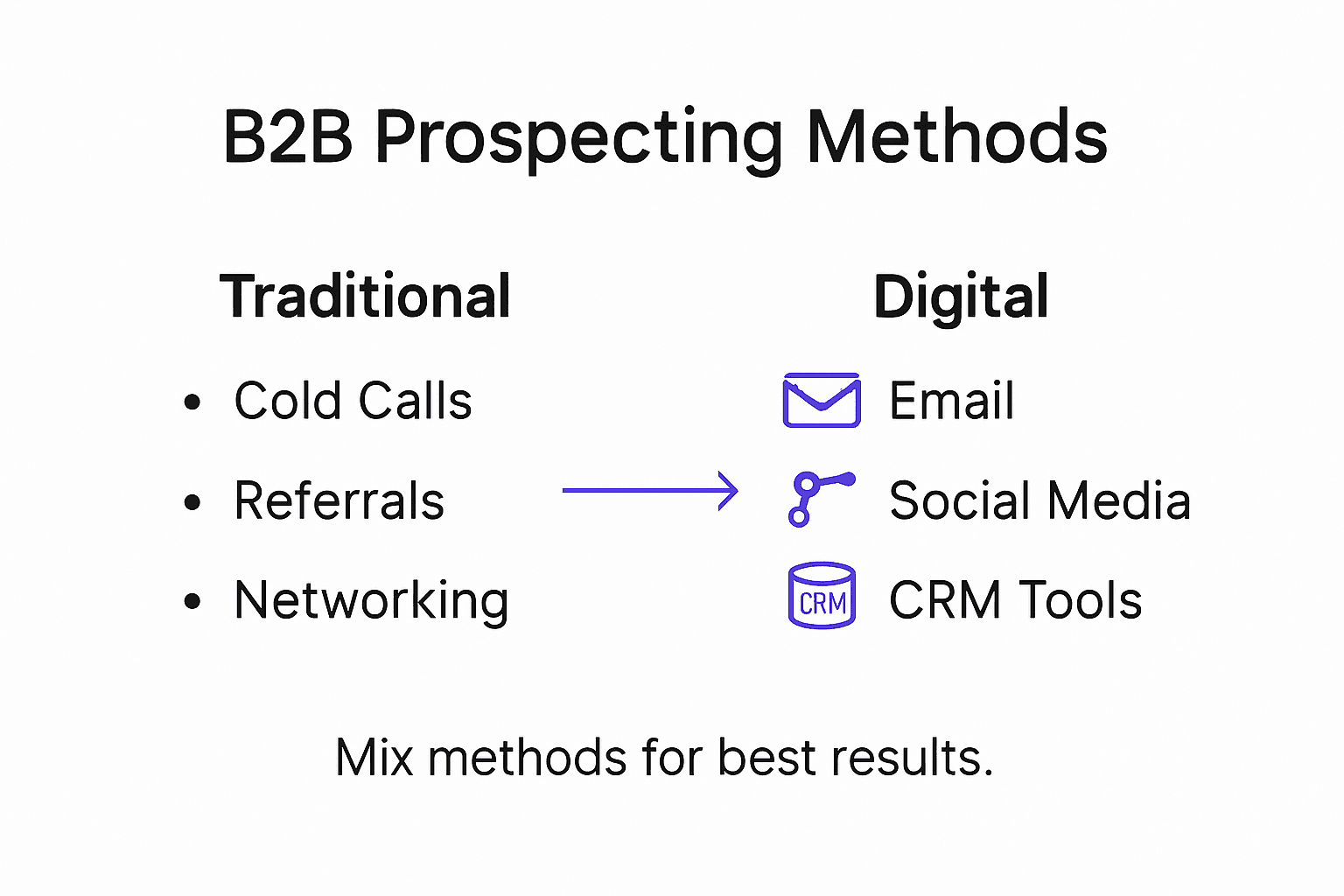
Digital prospecting methods have gained significant traction in recent years, incorporating sophisticated techniques like social selling, LinkedIn networking, content marketing, and targeted advertising. These approaches allow sales professionals to build credibility, demonstrate expertise, and create meaningful connections with potential business clients through strategic online engagement. Advanced prospecting now often integrates data-driven insights, leveraging sophisticated sales intelligence tools to identify and prioritize the most promising leads with precision and efficiency.
Pro Tip for Advanced Prospecting: Develop a multi-channel prospecting strategy that combines traditional outreach methods with digital engagement techniques, ensuring a comprehensive and adaptable approach to lead generation.
Here’s a concise comparison of major B2B prospecting methods and their ideal use cases:
| Prospecting Method | Typical Use Case | Key Advantage |
|---|---|---|
| Cold Outreach | Reaching new, unknown companies | Scales quickly |
| Warm Calling | Leveraging prior contact or mutual connection | Higher initial engagement |
| Referral Networking | Using client or partner introductions | Builds immediate trust |
| Digital Engagement | Interacting via social platforms and content | Supports targeted personalization |
How Technology Transforms B2B Prospecting
Technology has fundamentally revolutionized B2B prospecting, enabling sales teams to leverage sophisticated tools and data-driven approaches that dramatically enhance targeting and engagement strategies. Advanced machine learning techniques now allow businesses to develop hyper-personalized prospecting strategies that go far beyond traditional contact management.
Modern B2B prospecting technologies integrate powerful artificial intelligence and data analytics platforms that transform how companies identify, analyze, and engage potential clients. Predictive analytics and machine learning algorithms can now process complex datasets, generating insights that help sales professionals understand potential customer behaviors, preferences, and likelihood of conversion with unprecedented accuracy. These technological innovations enable businesses to move from generic outreach to highly targeted, contextually relevant engagement strategies that significantly improve conversion rates.

The emergence of sophisticated sales intelligence platforms has created new paradigms in prospecting, utilizing mixed logit models and machine learning algorithms to optimize product offerings and predict customer responses. These technologies allow sales teams to develop more nuanced understanding of potential client needs, create more compelling value propositions, and develop strategic approaches that align precisely with specific market segments. Integration of customer relationship management (CRM) systems, social media insights, and real-time data processing has transformed prospecting from a manual, time-consuming process into a streamlined, intelligent approach that maximizes efficiency and effectiveness.
Pro Tip for Tech-Driven Prospecting: Continuously invest in training your sales team on emerging technologies and data analysis tools, ensuring they can effectively leverage advanced prospecting platforms to identify and engage high-potential business opportunities.
This summary highlights how technology enhances each stage of modern B2B prospecting:
| Prospecting Stage | Traditional Challenge | Technological Benefit |
|---|---|---|
| Lead Identification | Manual, time-consuming search | Automated, AI-driven targeting |
| Qualification | Generic criteria, slow research | Predictive analytics for precision |
| Engagement | Mass emails, lack personalization | Data-driven, context-rich outreach |
| Tracking | Fragmented, error-prone records | Seamless CRM integration |
Integrating LinkedIn and CRM Tools Effectively
Effective integration of LinkedIn and Customer Relationship Management (CRM) tools represents a critical strategy for modern B2B sales professionals seeking to streamline their prospecting and relationship management processes. Social selling techniques have transformed how businesses approach potential client engagement, enabling more strategic and personalized communication approaches through sophisticated technological integrations.
The core of successful LinkedIn and CRM integration lies in creating a seamless data ecosystem that allows sales professionals to capture, track, and leverage professional network insights directly within their core business systems. Automated data synchronization enables instant transfer of contact information, professional details, and interaction histories between LinkedIn profiles and CRM platforms. This integration eliminates manual data entry, reduces potential errors, and provides a comprehensive view of potential client interactions, professional backgrounds, and engagement opportunities.
Advanced integration strategies go beyond simple contact management, incorporating sophisticated tracking mechanisms that help sales teams understand prospect behavior, monitor professional transitions, and identify potential engagement opportunities. By connecting LinkedIn’s rich professional networking data with CRM analytics, businesses can develop more nuanced lead scoring models, create more targeted outreach strategies, and build more meaningful professional relationships. These integrated approaches transform traditional prospecting from a transactional process into a strategic, insight-driven engagement methodology that prioritizes relationship building and value creation.
Pro Tip for CRM Integration: Implement a standardized workflow that automatically logs LinkedIn interactions, connection requests, and profile views directly into your CRM system, ensuring comprehensive tracking and minimizing administrative overhead.
Common B2B Prospecting Mistakes to Avoid
B2B prospecting is a nuanced process fraught with potential missteps that can dramatically undermine sales effectiveness. Common prospecting mistakes represent critical barriers that prevent sales teams from achieving optimal engagement and conversion rates, making awareness and proactive prevention essential for success.
One of the most significant errors in B2B prospecting involves inadequate target research and overly generic outreach strategies. Personalization deficiency remains a fundamental problem, where sales professionals fail to deeply understand their potential client’s specific business context, challenges, and unique value propositions. This lack of targeted approach results in low-quality interactions that fail to resonate with decision makers, essentially rendering prospecting efforts ineffective and wasteful. Successful prospecting demands meticulous account research, understanding organizational structures, and developing communication strategies that demonstrate genuine understanding of a prospect’s specific business ecosystem.
Another critical mistake in B2B prospecting stems from misalignment between sales and marketing teams, which creates fragmented communication and inconsistent messaging. Effective prospecting strategies require seamless collaboration, ensuring that outreach efforts are coherent, data-driven, and strategically coordinated. Sales professionals must develop comprehensive understanding of their ideal customer profile, leverage data-informed insights, and create multifaceted engagement approaches that transcend traditional cold calling or generic email campaigns. This holistic approach demands continuous learning, adaptability, and a commitment to understanding evolving market dynamics and customer communication preferences.
Pro Tip for Prospecting Success: Develop a systematic approach to prospect research by creating detailed ideal customer profiles that incorporate demographic, technographic, and behavioral data, enabling more precise and meaningful engagement strategies.
Streamline Your B2B Prospecting with LeadLx
The article highlights common challenges in B2B prospecting like inefficient outreach, poor data accuracy, and the struggle to integrate LinkedIn insights directly with CRM platforms. If you find yourself overwhelmed by manual data entry, generic messaging, or fragmented sales processes, you are not alone. Sales professionals need a solution that brings together personalized LinkedIn engagement and seamless CRM synchronization to boost prospecting effectiveness and save valuable time.
LeadLx is designed to solve these exact pain points. With its browser extension, it overlays HubSpot and Salesforce data right onto LinkedIn profiles, allowing instant extraction and one-click updates of contact and company information. This means no more switching tabs or repetitive manual entries. By automating data capture and offering bulk extraction from LinkedIn search results, LeadLx empowers your team to focus on building meaningful connections and closing deals faster.
Are you ready to transform your prospecting from a time-consuming task into a streamlined, insight-driven process that fuels sales success?
Experience the power of integrated LinkedIn and CRM prospecting tools at LeadLx. Don’t wait to reclaim your time and improve your sales outcomes. Start today and see how easy targeted B2B prospecting can be when your technology works together effortlessly.
Frequently Asked Questions
What is B2B prospecting?
B2B prospecting is the systematic process of identifying, researching, and engaging potential business customers who may benefit from a company’s products or services.
Why is B2B prospecting important?
B2B prospecting is crucial because it helps businesses identify potential revenue opportunities, transform unknown contacts into meaningful relationships, and ultimately drive sales growth by targeting the right clients.
What are the main methods of B2B prospecting?
The main methods of B2B prospecting include cold outreach, warm calling, referral networking, and digital engagement strategies like social selling and content marketing.
How has technology changed B2B prospecting?
Technology has drastically improved B2B prospecting by enabling data-driven insights, automating lead identification, and providing sophisticated tools for personalized engagement, enhancing the efficiency and effectiveness of prospecting efforts.