
Most american sales teams lose valuable time to manual prospecting routines, with studies showing that inefficient workflows can reduce productivity by as much as 40 percent. In today’s competitive landscape, every hour saved can mean an edge over rivals chasing the same leads. Taking a closer look at enhanced prospecting workflows reveals how technology and smart process design help american businesses move from slow, error-prone methods to more efficient and effective sales strategies.
Key Takeaways
| Point | Details |
|---|---|
| Enhanced Prospecting Workflows | These workflows integrate automation and intelligent technologies to boost sales team efficiency and effectiveness. |
| Workflow Optimization Advantages | Optimizing workflows leads to reduced manual work, increased accuracy in data management, and improved team collaboration. |
| CRM Integration Significance | Effective CRM integration enhances lead capture, real-time data syncing, and intelligent scoring, streamlining prospect management. |
| Common Prospecting Pitfalls | Recognizing key inefficiencies like redundant data entry and lack of real-time synchronization can help sales teams refine their processes. |
Defining Enhanced Prospecting Workflows
Enhanced prospecting workflows represent strategic approaches designed to streamline and optimize the lead generation and customer acquisition process. These advanced workflows go beyond traditional manual methods, integrating intelligent technologies and systematic processes to dramatically improve sales team efficiency. By leveraging workflow optimization techniques, businesses can transform their prospecting strategies into precision-driven systems.
At its core, an enhanced prospecting workflow includes several key components that distinguish it from conventional approaches. Automation plays a critical role, enabling sales professionals to reduce repetitive tasks and focus on high-value interactions. The workflow typically encompasses intelligent data capture, automated lead scoring, personalized outreach strategies, and seamless CRM integration. Unlike traditional linear processes, these workflows are dynamic – adapting and learning from each interaction to refine targeting and engagement strategies.
The primary objectives of enhanced prospecting workflows center on three fundamental goals: increasing efficiency, improving lead quality, and accelerating conversion rates. Sales teams implementing these sophisticated workflows can expect significant improvements in their overall performance. By generating comprehensive, structured research workflows, organizations create repeatable, scalable processes that minimize human error and maximize strategic potential. Key benefits include:
- Reduced manual data entry
- More accurate lead targeting
- Faster lead qualification
- Improved team collaboration
- Enhanced data-driven decision making
Understanding and implementing enhanced prospecting workflows represents a critical evolution in modern sales strategies – transforming prospecting from a time-consuming task into a precise, intelligent system.
Key Benefits of Workflow Optimization
Workflow optimization offers transformative advantages for sales and marketing teams seeking to enhance their prospecting efficiency. Workflow management systems have demonstrated substantial improvements in business process speed and operational effectiveness, enabling organizations to dramatically reshape their lead generation strategies. By systematically analyzing and refining existing processes, teams can unlock significant performance gains that extend far beyond traditional manual approaches.

The most compelling benefit of workflow optimization lies in its ability to dramatically reduce time-consuming manual tasks. Healthcare workflow research reveals potential efficiency gains that translate directly to sales environments, with potential documentation time reductions approaching 45%. This translates into more time for high-value activities like customer engagement, relationship building, and strategic planning. Sales professionals can redirect energy from repetitive administrative work toward activities that genuinely drive revenue and business growth.
Critical benefits of workflow optimization include:
- Enhanced productivity through automated processes
- Increased accuracy of data collection and management
- Reduced human error and manual intervention
- Improved team collaboration and communication
- More precise lead targeting and qualification
- Scalable and repeatable business processes
Ultimately, workflow optimization represents a strategic approach to transforming sales operations. By embracing intelligent, data-driven methodologies, organizations can create more responsive, efficient, and competitive prospecting systems that adapt quickly to changing market dynamics.
Role of CRM Integration and Automation
CRM integration and automation represent transformative strategies that fundamentally reshape how sales teams capture, manage, and leverage prospect information. Advanced workflow evaluation frameworks now enable organizations to mathematically model and optimize their customer relationship management processes, creating more intelligent and responsive systems that go beyond traditional data tracking.
Automation technologies have revolutionized the prospecting landscape by eliminating repetitive manual tasks and creating seamless data flows between different sales platforms. Executable workflows generated from strategic intentions allow teams to design complex interaction sequences that automatically capture, score, and route potential leads. These sophisticated systems can instantly transform raw contact information into structured, actionable insights, dramatically reducing the time and effort required for lead qualification.
Key components of effective CRM integration and automation include:
- Automatic lead capture and data enrichment
- Real-time contact information synchronization
- Intelligent lead scoring and prioritization
- Seamless communication tracking across multiple channels
- Predictive analytics for sales forecasting
- Customizable workflow design for specific business needs
By embracing these advanced integration strategies, sales organizations can create more agile, responsive, and data-driven prospecting ecosystems that adapt quickly to changing market dynamics and individual customer interactions.
Improving Data Accuracy and Team Collaboration
Improving data accuracy and team collaboration represents a critical strategic objective for modern sales organizations seeking to optimize their prospecting workflows. Systematic workflow categorization techniques have emerged as powerful methods for enhancing data management, breaking down complex processes into distinct stages that enable more precise information handling and team coordination.
Data integrity stands at the core of effective prospecting strategies, with advanced fault-tolerant workflow scheduling algorithms providing sophisticated mechanisms to prevent errors and ensure reliable information capture. These innovative approaches allow sales teams to implement robust checkpointing systems that minimize data discrepancies, create transparent communication channels, and establish a single source of truth across different departments and platforms.
Key strategies for improving data accuracy and team collaboration include:
- Implementing centralized data management systems
- Creating standardized data entry protocols
- Establishing real-time synchronization across platforms
- Developing comprehensive data validation processes
- Promoting transparent team communication channels
- Utilizing automated error detection and correction mechanisms
By embracing these advanced collaboration techniques, sales organizations can transform their prospecting workflows into dynamic, interconnected systems that prioritize data quality, team alignment, and continuous improvement. The result is a more agile, responsive approach to lead generation that minimizes errors and maximizes collective team performance.
Common Pitfalls of Inefficient Prospecting
Workflow management system implementations often face significant challenges that can derail sales team productivity and lead to substantial performance losses. Most organizations struggle with deeply ingrained inefficiencies that prevent them from achieving optimal prospecting outcomes, with research indicating that only half of such transformation efforts successfully reach their intended goals.
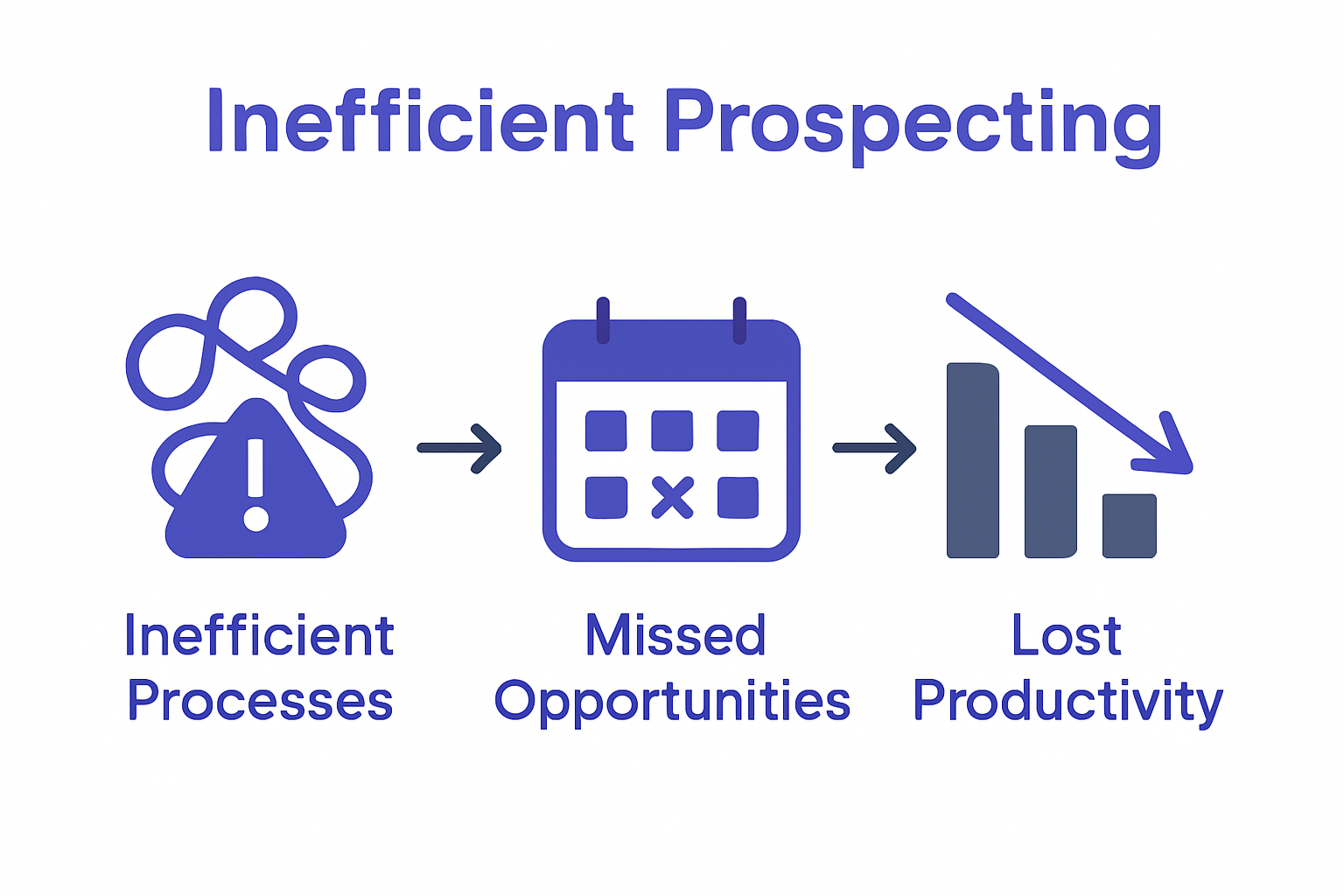
Manual data processing represents one of the most critical bottlenecks in prospecting workflows. Existing workflow scheduling approaches frequently lack the reliability and robustness required to handle complex sales interactions, resulting in data inconsistencies, missed opportunities, and significant time wastage. These inefficiencies manifest through multiple interconnected problems that systematically undermine sales team performance.
Common pitfalls that plague inefficient prospecting workflows include:
- Redundant data entry across multiple platforms
- Inconsistent lead qualification processes
- Lack of real-time information synchronization
- Manual tracking of prospect interactions
- Insufficient data validation mechanisms
- Unstructured communication channels
- Limited visibility into sales pipeline performance
By recognizing and addressing these fundamental workflow challenges, sales teams can transform their prospecting approach from a fragmented, error-prone process into a streamlined, data-driven system that maximizes efficiency and accelerates revenue generation.
Boost Your Prospecting with Smarter CRM Integration and Automation
The article highlights critical challenges like manual data entry, inconsistent lead qualification, and the need for seamless CRM integration to improve data accuracy and team collaboration. If you are facing these roadblocks in your prospecting workflows, you understand how much time can be lost on repetitive tasks and scattered information. Enhanced prospecting workflows rely heavily on automation, real-time synchronization, and intelligent lead scoring to optimize sales efforts and convert leads faster.
LeadLx offers the perfect solution to overcome these pain points. By integrating LinkedIn directly with CRM platforms like HubSpot and Salesforce, LeadLx eliminates the need to switch between tabs and manually update records. This saves you about 10 hours every week while reducing errors and boosting your team’s coordination. With features such as automatic contact capture, bulk data extraction, and instant CRM updates, your prospecting transforms into a precise, efficient, and connected process.
Experience how LeadLx streamlines your lead generation and enriches your CRM workflows with unmatched ease. Discover more about how our browser extension overlays HubSpot data onto LinkedIn and why smarter automation matters to sales teams aiming for higher conversion rates.
Take control of your prospecting now before inefficiencies cost you more leads. Visit https://leadlx.com and start saving hours while improving data accuracy and collaboration today.

Frequently Asked Questions
What are enhanced prospecting workflows?
Enhanced prospecting workflows are strategic approaches designed to streamline lead generation and customer acquisition. They integrate intelligent technologies and systematic processes to improve sales team efficiency and transform traditional prospecting methods into precise systems.
How can workflow optimization benefit sales teams?
Workflow optimization can dramatically reduce time-consuming manual tasks, enhance productivity through automation, and improve data accuracy. This allows sales teams to focus more on high-value activities, like customer engagement and relationship building, rather than administrative work.
What role does CRM integration and automation play in prospecting workflows?
CRM integration and automation automate repetitive tasks, create seamless data flows, and enable real-time lead capture and prioritization. By leveraging these technologies, sales teams can enhance their prospecting effectiveness and adapt their strategies based on customer interactions and market dynamics.
What are common pitfalls associated with inefficient prospecting?
Common pitfalls include redundant data entry, inconsistent lead qualification, lack of real-time information synchronization, and unstructured communication channels. These inefficiencies can undermine sales performance, leading to missed opportunities and wasted time.